Home LFKP D-PHYS ETH Zurich
ETH Zurich Quantum Device Lab
Header image
  • Lab
    • Mission Statement
    • Gallery
    • Open Positions
    • Location
    • Contact
    • Safety
  • Team
    • Team
    • Team Members
    • Alumni
    • Visitors
  • Research
    • Research Topics
    • Projects/Cooperations
    • Collaborations
    • Publications
    • Theses
    • Conferences
  • Education
    • Physik I (HS 2018)
    • QIP II (Archiv)
      • QIP II (FS 2018)
      • QIP II (FS 2017)
    • QSIT (Archive)
      • QSIT (FS 2016)
      • QSIT (FS 2015)
      • QSIT (FS 2014)
      • QSIT (FS 2013)
      • QSIT (HS 2012)
    • Physik I (Archiv)
      • Physik I (HS 2017)
      • Physik I (HS 2016)
    • Physik III / IV (Archiv)
      • Physik III (HS 2015)
      • Physik III (HS 2013)
      • Physik IV
    • Summer Schools
      • SanSebastian 2016
      • CoQuS School 2013
      • Les Houches 2012
      • DPG-Lehrerfortbildung
    • Winter Schools
      • NCCR QSIT Arosa 2015
  • News
    • Research News
    • Lab News
    • Media Coverage

Gallery

Beam me up!  This photomontage of scientists in the Quantum Device Lab was taken for the December 2013 issue of ETH life magazine. From left: Yves Salathé, Andreas Wallraff, Lars Steffen, Nikola Pascher and Klaus Ensslin. (Image: ETH Zurich)
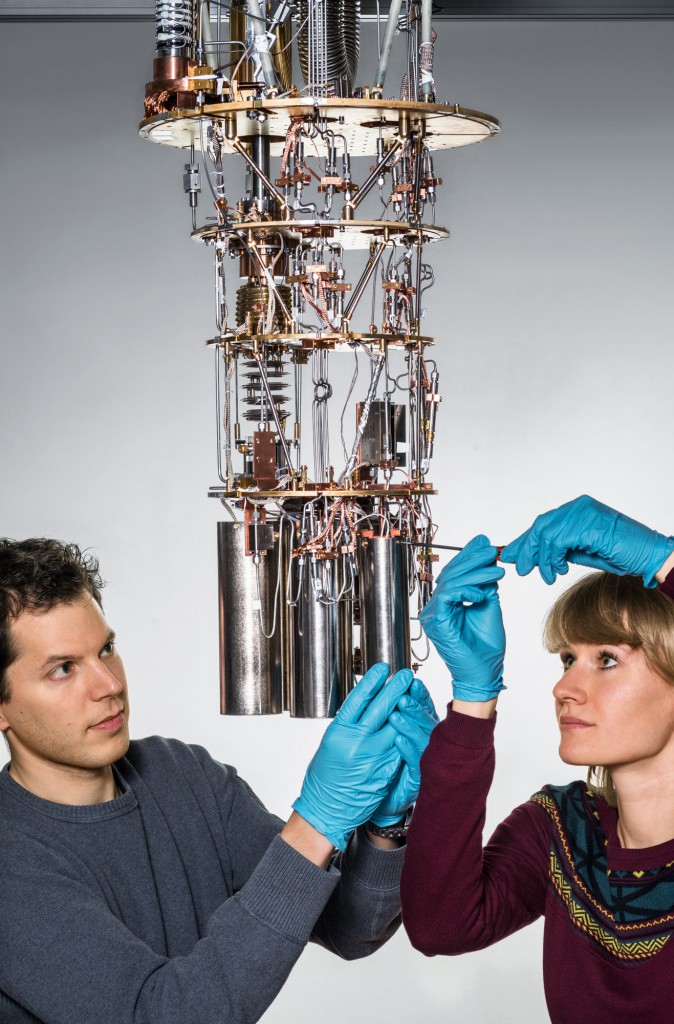
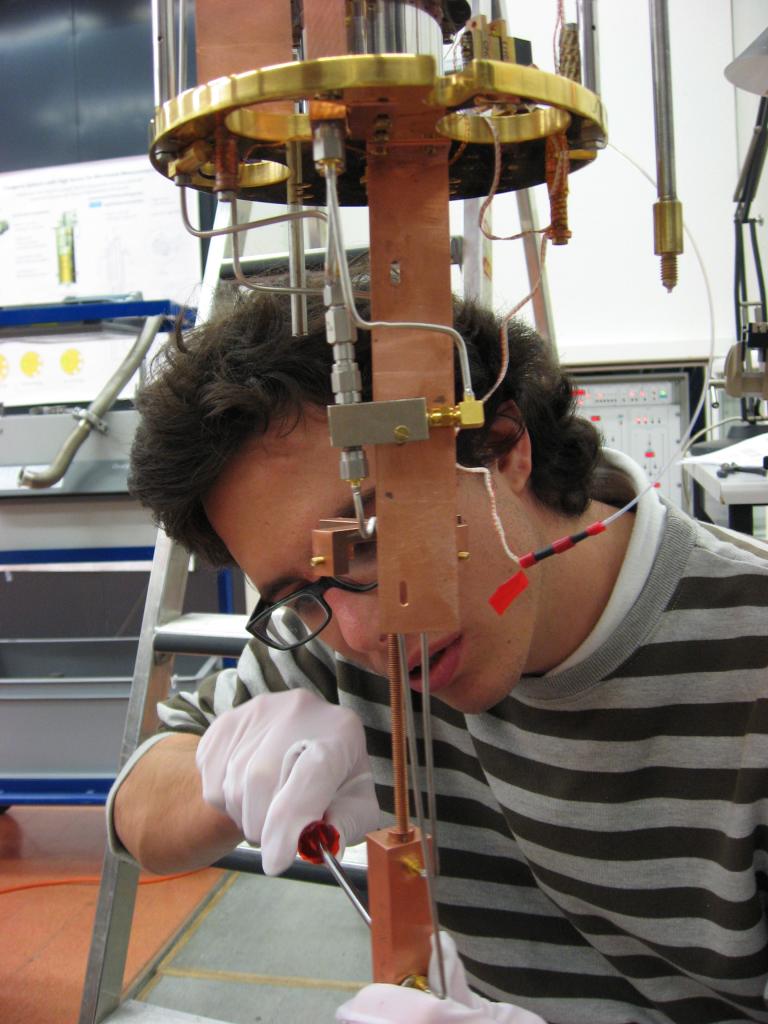
Cover image of ETH life magazine, December 2013 issue. Lars Steffen and Anna Stockklauser are working on a delution refrigerator used to explore the quantum properties of electronic devices. (Image: ETH Zurich)
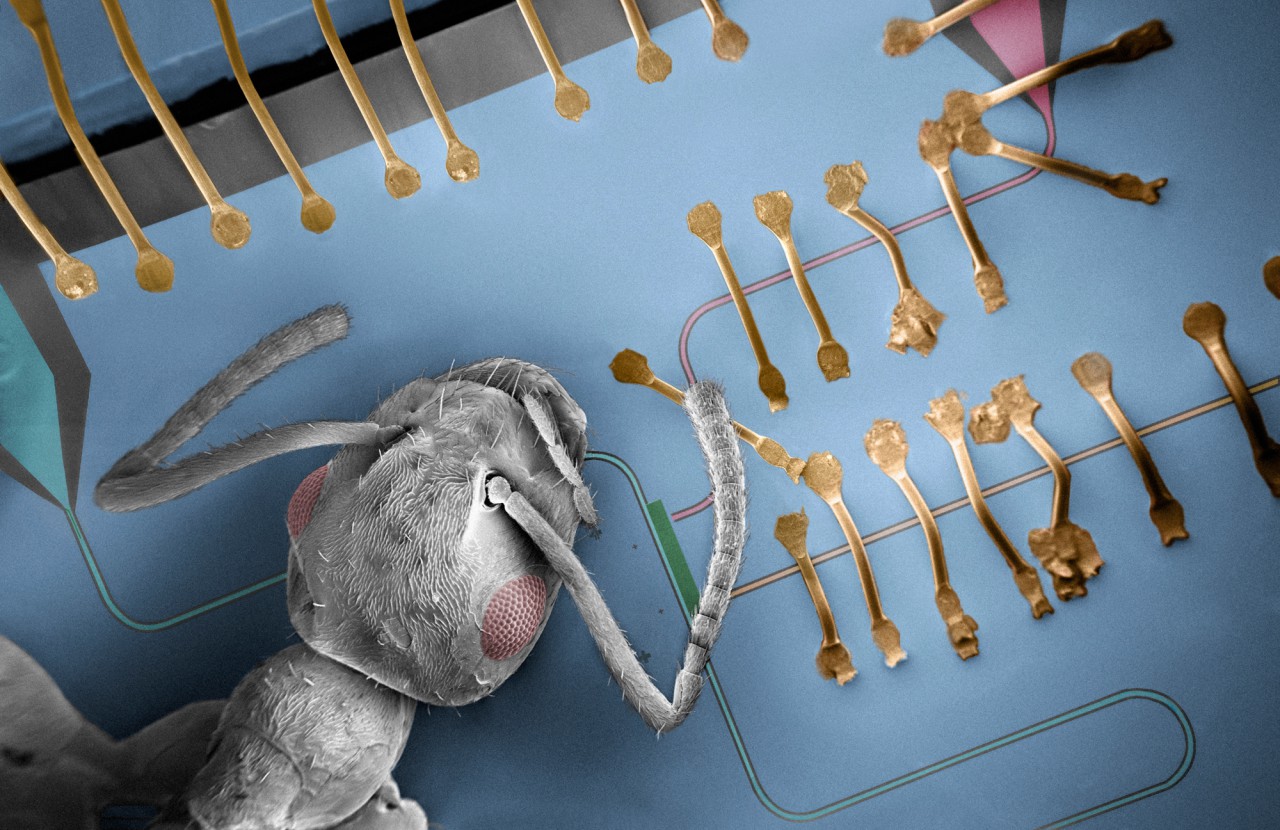
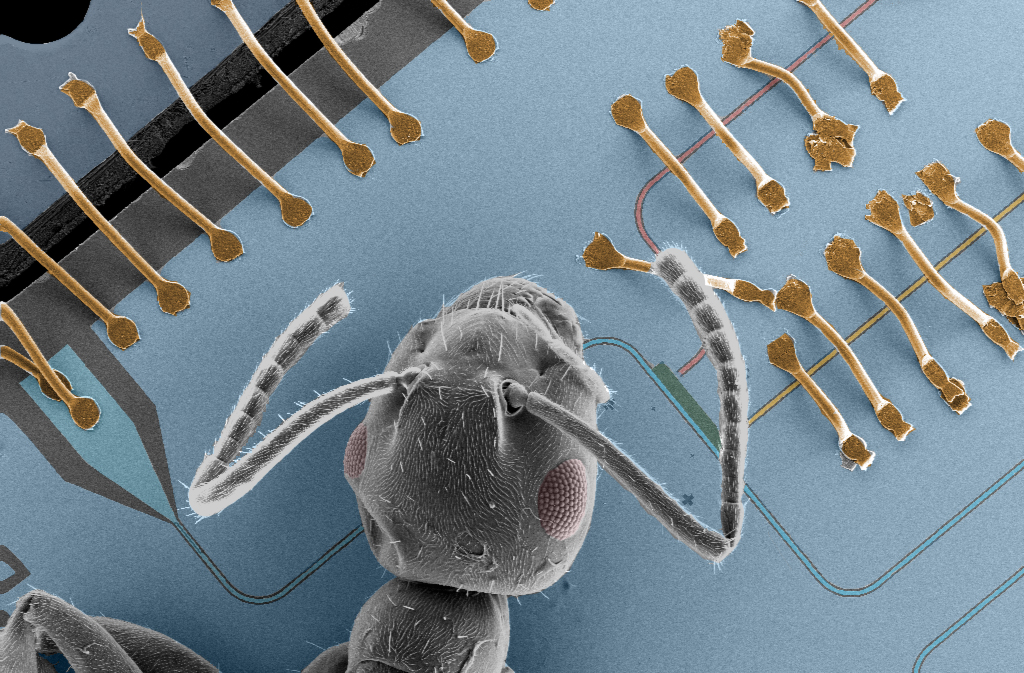
Cover illustration of the annual report 2013 of ETH Zurich. The ant depicted on top of the superconducting circuit illustrates the relative proportions of the macroscopic electrical circuits used for teleportation experiments. (Image: Jonas Mlynek, Quantum Device Lab, ETH Zurich)
Two superconducting qubits collectively emit their radiation to a fast on chip microwave transmission line resonator. The quantum state of the field can be fully characterized by a matrix representation in the photon number basis. (Image: Jonas Mlynek, Quantum Device Lab, ETH Zurich)
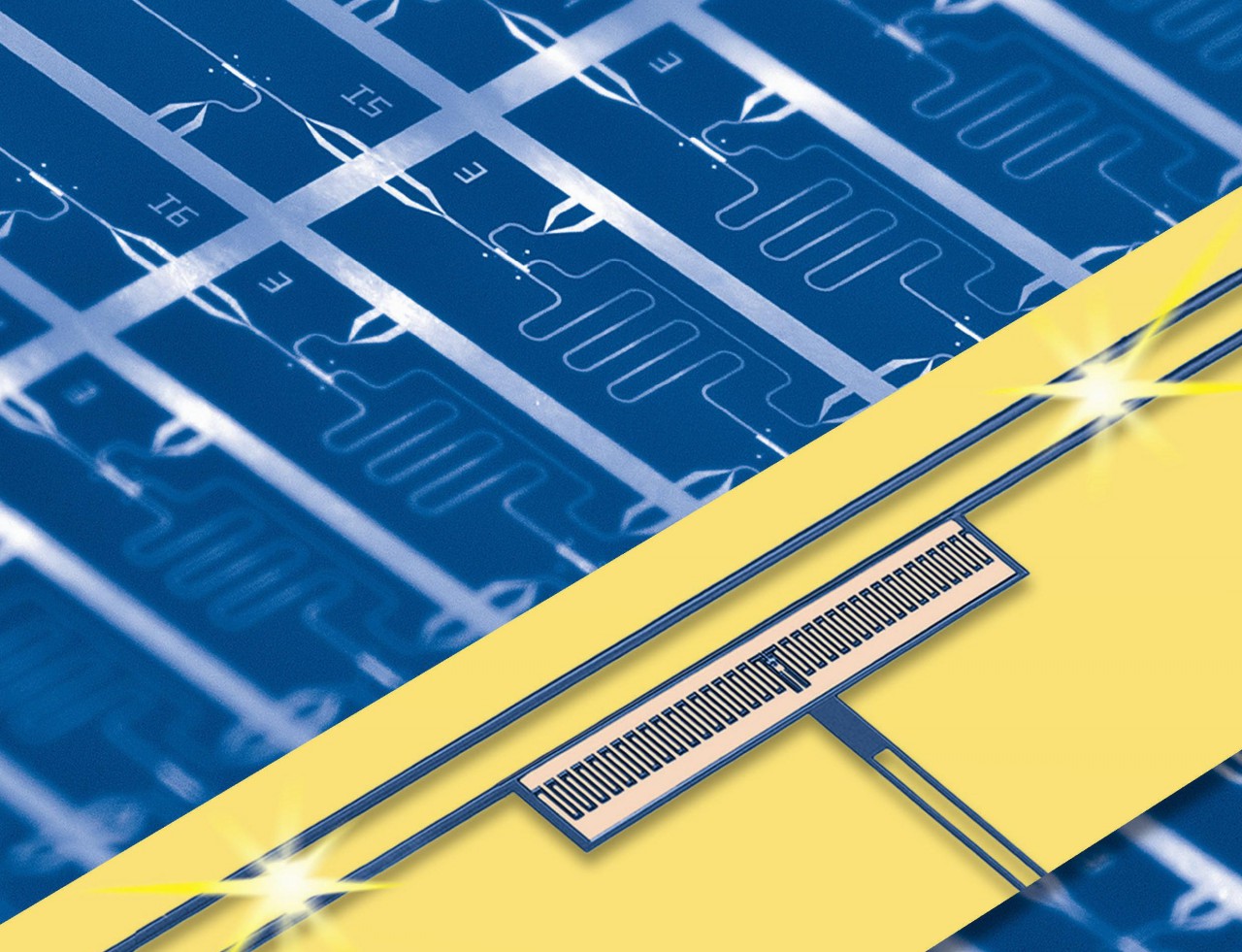
The image shows microchips fabricated in the FIRST clean-room facilities at ETH Zurich. The background photograph depicts a set of microwave resonators that are used to store and manipulate single or multiple microwave photons. In the foreground a false-color microscope image of a superconducting artificial atom (zick-zack structure) which is integrated into such a resonator is shown together with an artist's impression of two photons traveling along the resonator and approaching the artificial atom. (Image
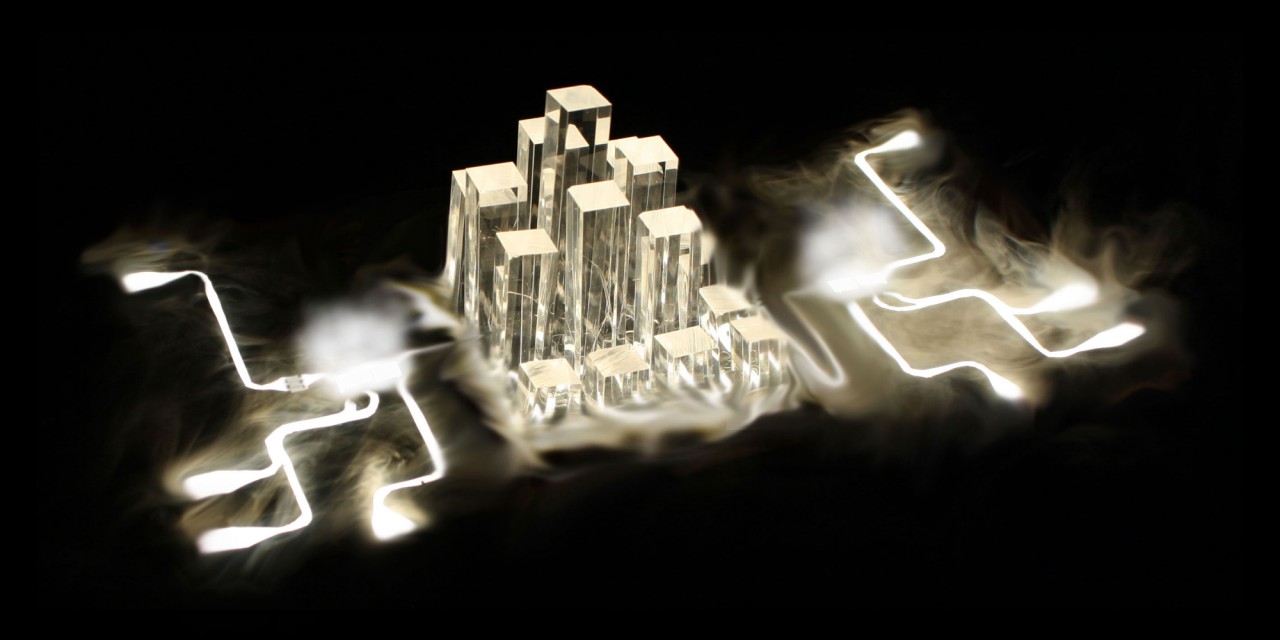
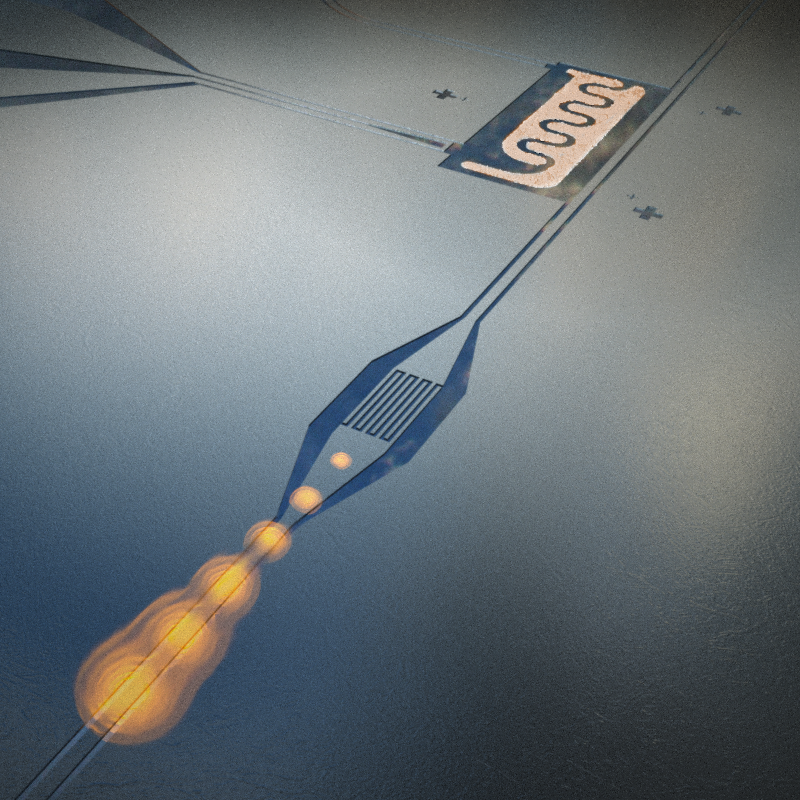
Render of a section of the superconducting chip used for the experiment with the transmon qubit highlighted in orange (M. Pechal, et al., Phys. Rev. X 4, 041010, 2014).  The chain of lights in the lower left corner is an artistic impression of the emitted multipeaked photon. (Image: Marek Pechal, Quantum Device Lab, ETH Zurich)
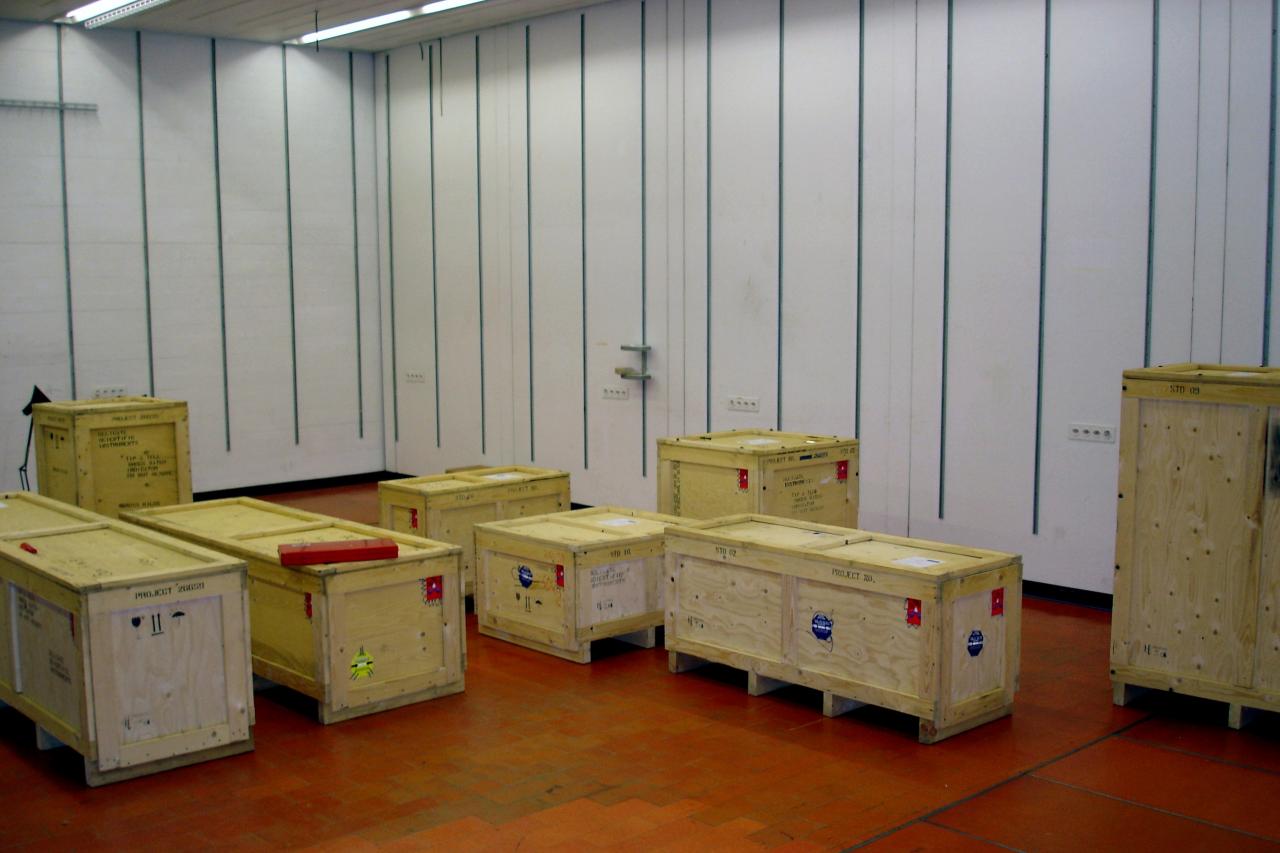
Cryogenic Lab 2006: Delivery of the first cryogenic system of the Quantum Device Lab. (Image: Quantum Device Lab, ETH Zurich)
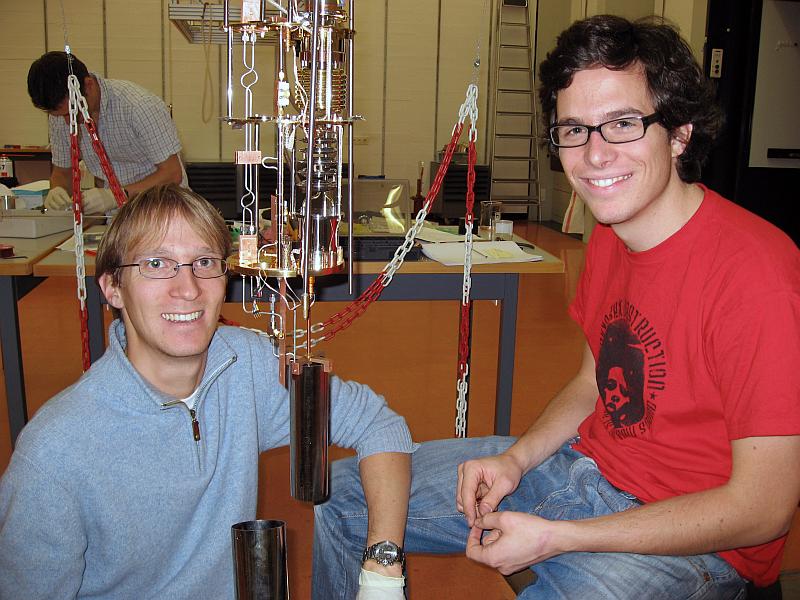
Cryogenic Lab 2006: Johannes Fink is assembling the first cryostat. (Image: Quantum Device Lab, ETH Zurich)
Cryogenic Lab 2006: Romeo Bianchetti, Johannes Fink  (seen in the foreground from left) and Peter Leek in the background are building up the measurement equipment. (Image: Quantum Device Lab, ETH Zurich)
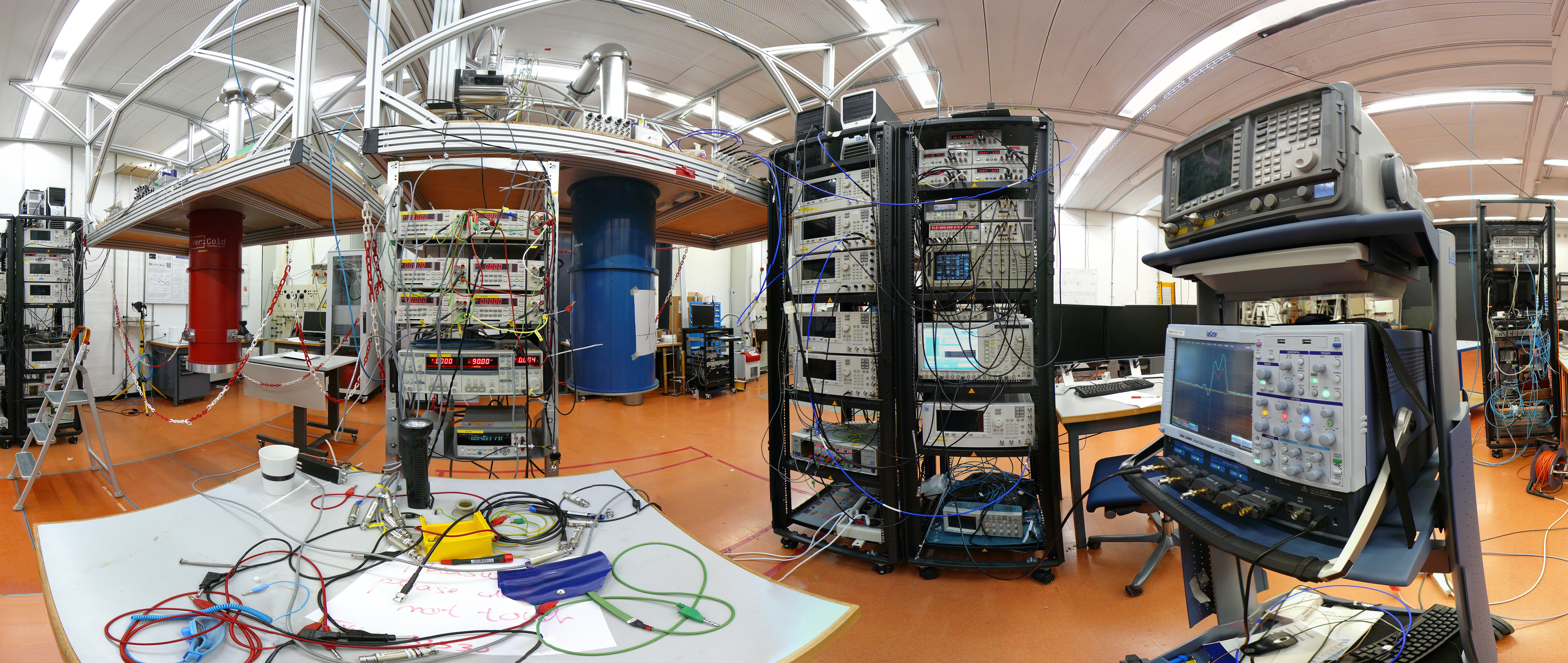
Cryogenic Lab 2012: Cryogenic and microwave frequency apparatus. (Image: Quantum Device Lab, ETH Zurich)
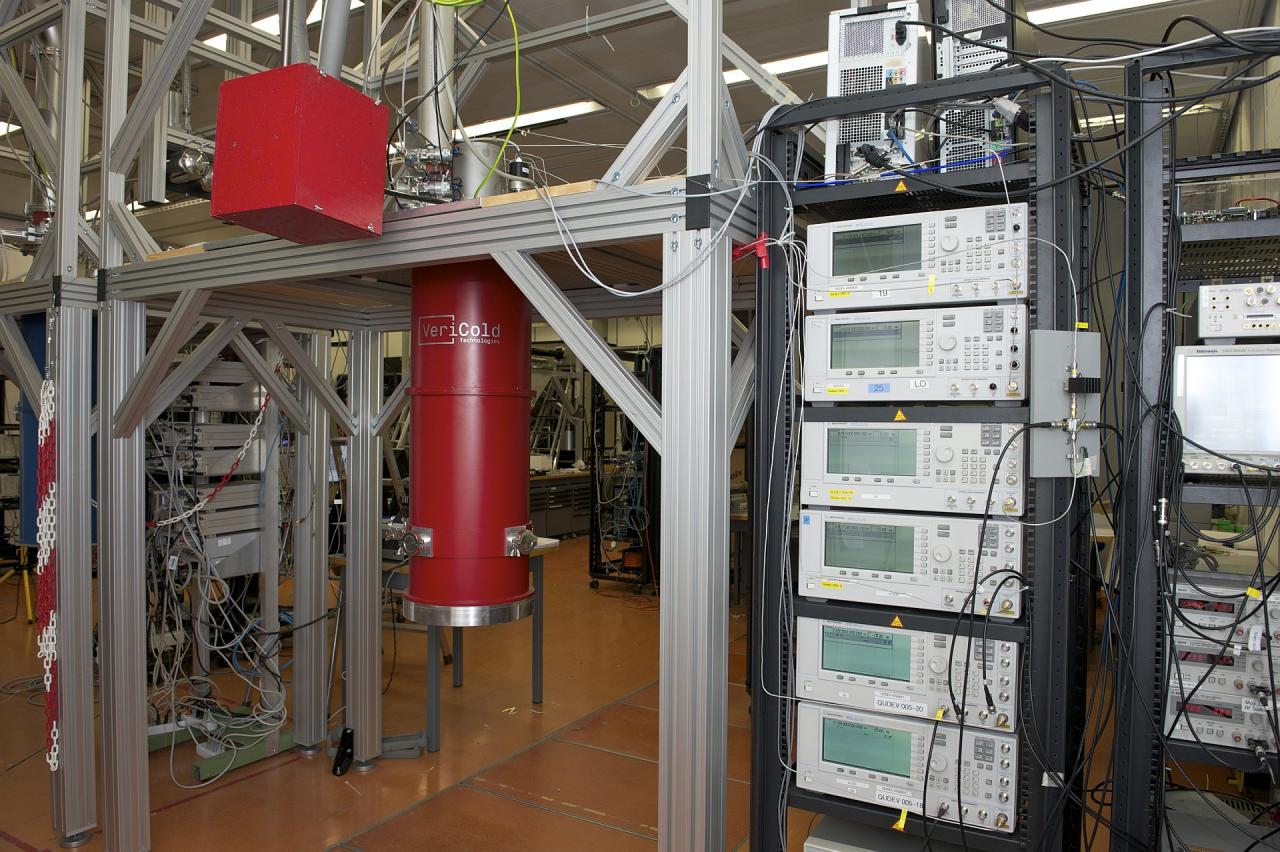
Cryogenic Lab 2012: The experiments are carried out in a cryostat below 0.02 Kelvin (close to the absolute zero), seen in the background in red and involve a considerable amount of microwave frequency control electronics equipment (front right). (Image: Heidi Hostettler, ETH Zurich)
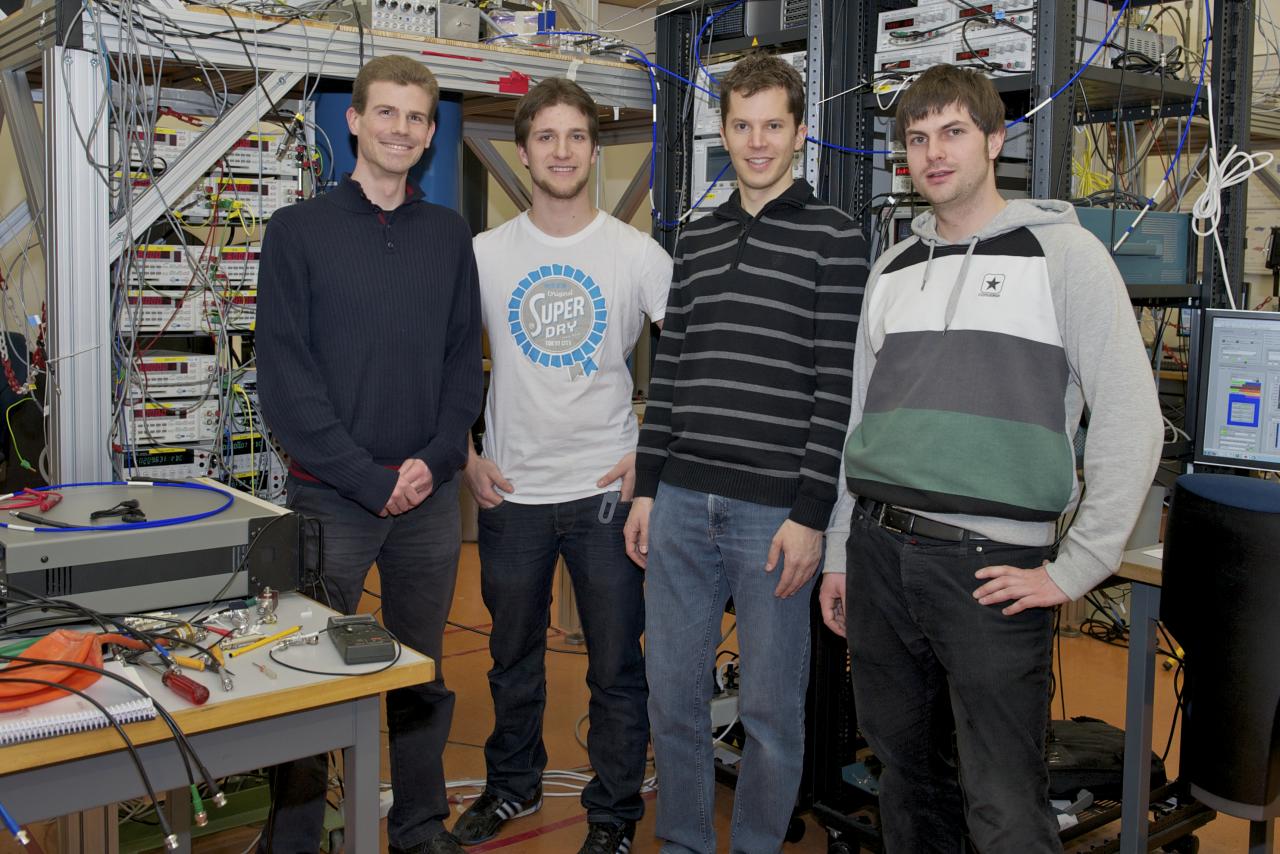
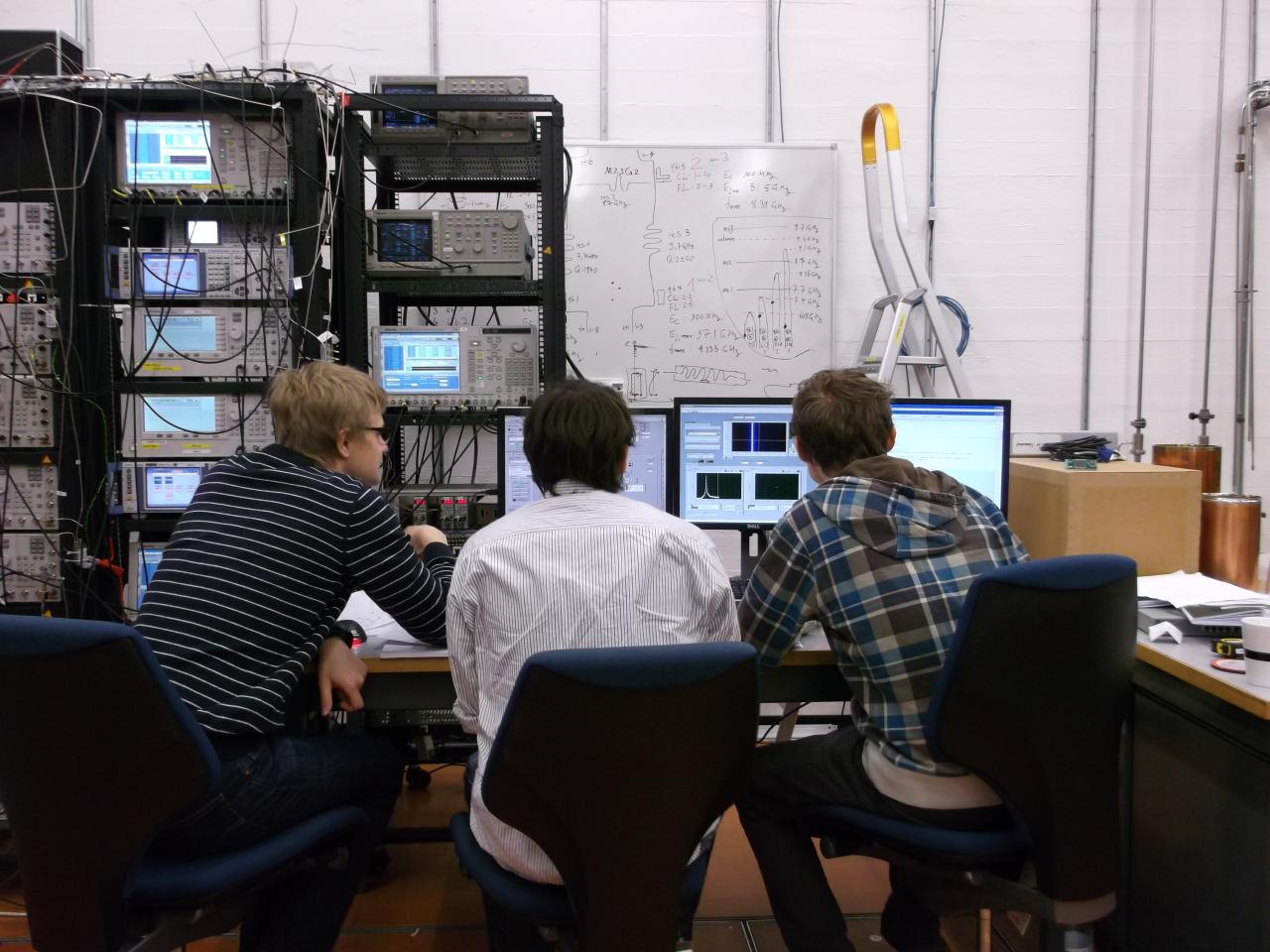
Cryogenic Lab 2012:  Part of the team in front of the microwave frequency control an measurement setup. From left: Christian Lang, Janis Lütolf, Lars Steffen, Jonas Mlynek. (Image: Heidi Hostettler, ETH Zurich)
Cryogenic Lab 2012: Lars Steffen is working on the cryostate. (Image: Heidi Hostettler, ETH Zurich)
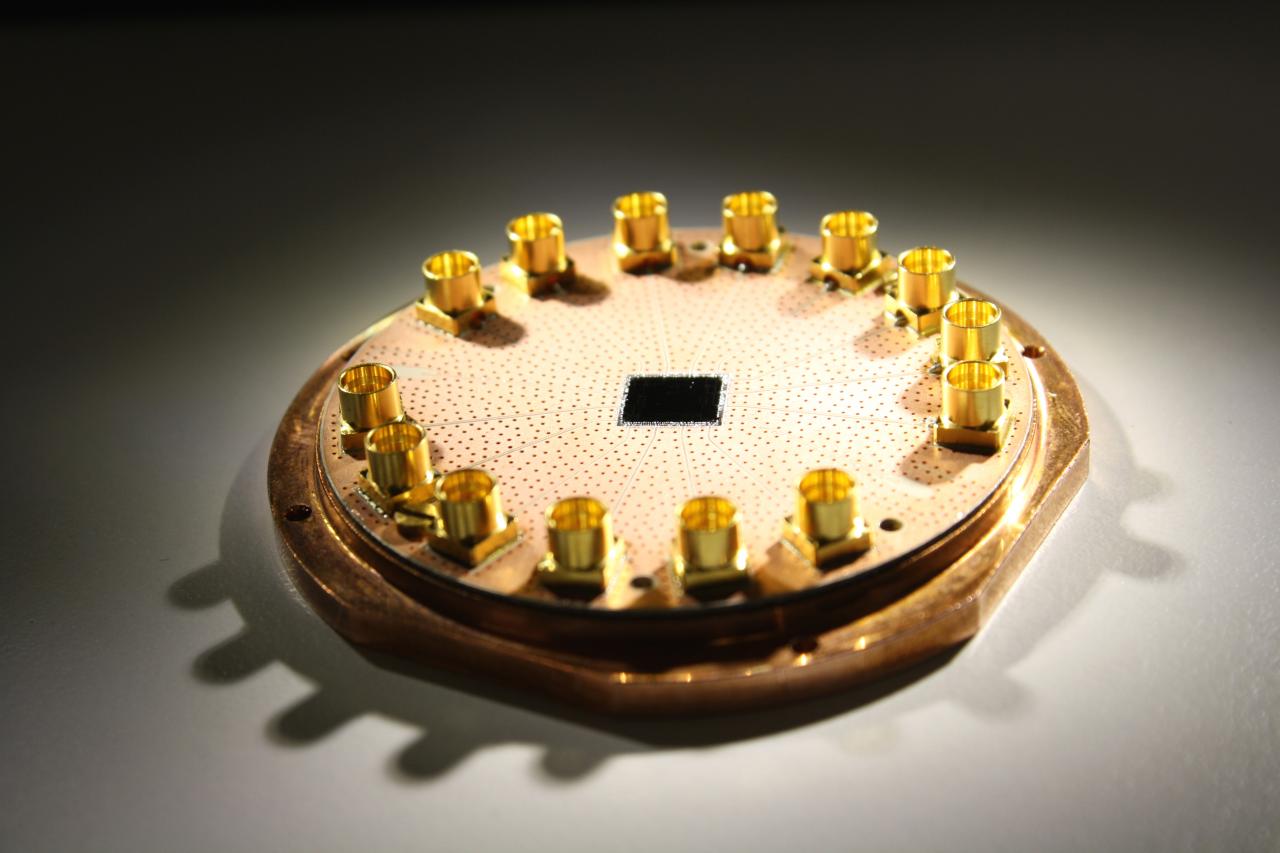
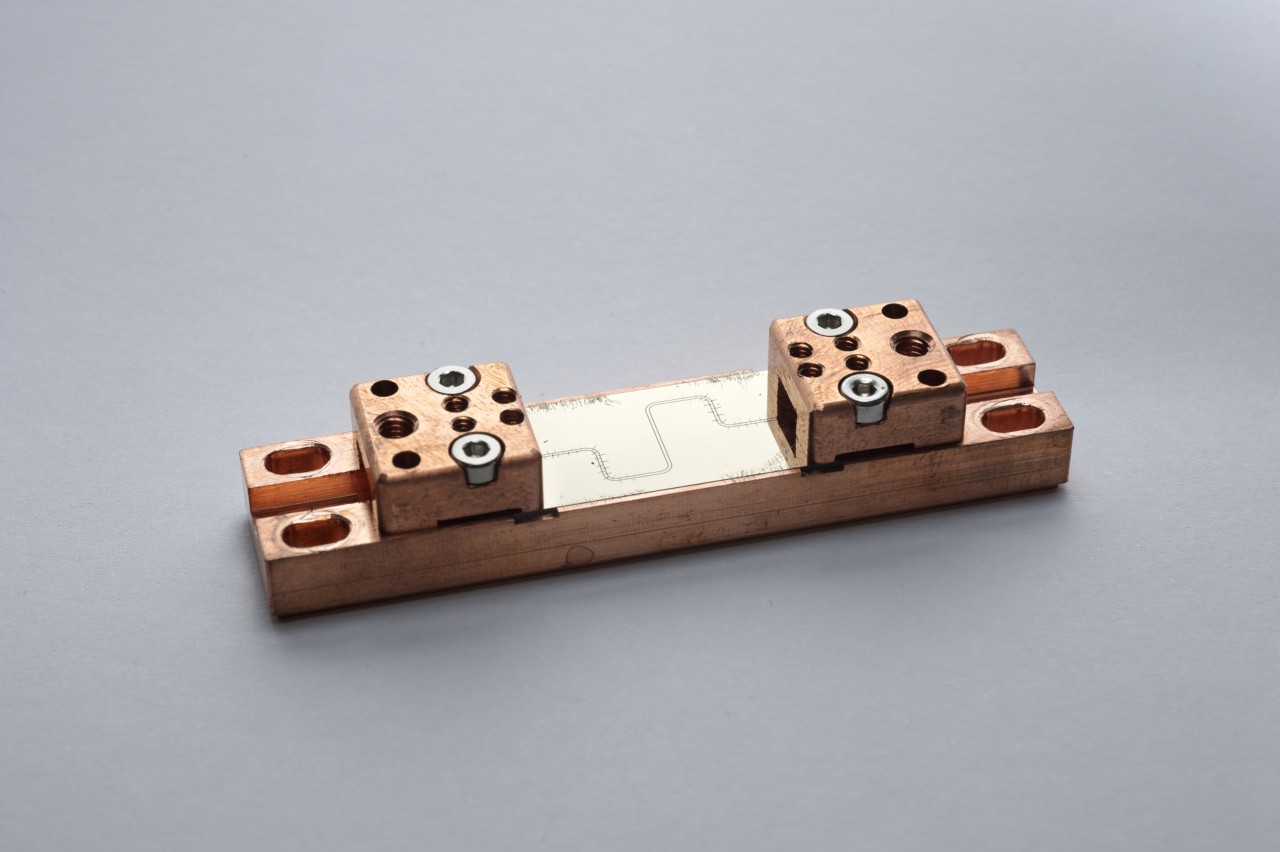
Experiments: The microchip with several transmons and resonators is glued on the printed circuit board. The printed circuit board is then fixed on the sample holder. Each transmon can be manipulated by its charge line and its flux line. (Image: Yulin Liu, Quantum Device Lab, ETH Zurich)
Experiments: The microchips are mounted inside the cryostat. (Image: Quantum Device Lab, ETH Zurich)
Experiments: Philipp Kurpiers, Markus Oppliger and Yves Salathé (from left) are analyzing the results. (Image: Quantum Device Lab, ETH Zurich)
Cryogenic Lab 2021: To operate the superconducting qubits, the chips are cooled down to temperatures lower than 10 millikelvin in a cryostat. (Image: Quantum Device Lab, ETH Zurich)
Cryogenic Lab 2021: The different plates inside of a cryostat delimit the volumes inside of the cryostat that are operated at different temperatures. The lowest plate and the volume underneath it can be cooled down to as low as 2 mK. (Image: Daniel Winkler, ETH Zurich)
Cryogenic Lab 2021: A 17-qubit chip, mounted on a printed circuit board. (Image: Quantum Device Lab, ETH Zurich)
Cryogenic Lab 2021: Nathan Lacroix (left) and Sebastian Krinner (right) are adjusting the chip's wiring before its use in the cryostat. (Image: Daniel Winkler, ETH Zurich)
Cryogenic Lab 2021: The wires leading to the chip are made of special materials that allow to work reliably with the quantum processor even at extremely low temperatures. (Image: Daniel Winkler, ETH Zurich)
Cryogenic Lab 2021: The qubit devices in the cryostat on the right are controlled by signals from the arbitrary waveform generators and microwave generators on the left. (Image: Daniel Winkler, ETH Zurich)
Cryogenic Lab 2021: Photo of the Edelweiss setup. (Image: Colin Scarato, Quantum Device Lab, ETH Zurich)
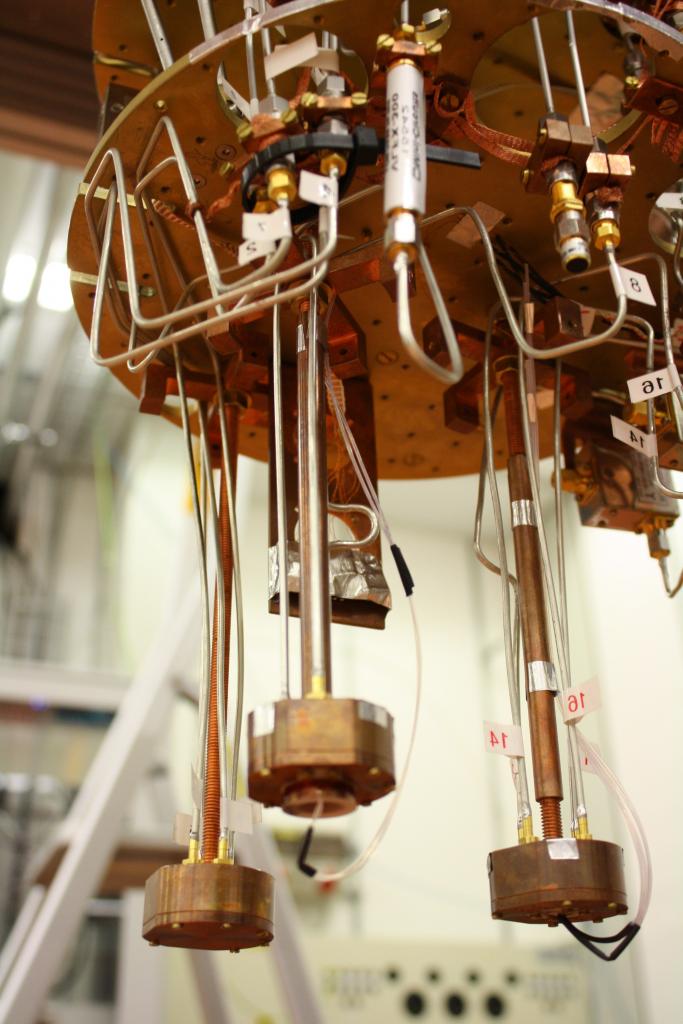
Cryogenic Lab 2021: A dilution fridge cryostat with the outer vacuum chamber and radiation shields removed, showing the various cooling stages and cabling. The grey cylinders at the bottom are magnetic shields, inside which sit superconducting devices used for quantum entanglement experiments. (Image: James O'Sullivan, Quantum Device Lab, ETH Zurich)
Cryogenic Lab 2021: Quantum processors and quantum limited amplifiers are mounted inside copper boxes and hung underneath the base plate of a dilution fridge cryostat. (Image: James O'Sullivan, Quantum Device Lab, ETH Zurich)
Cryogenic Lab 2021: Densely packed microwave coaxial cables, filters and copper mounting parts for operation of a quantum entanglement knitting device. This illustrates how much wiring and hardware must be packed in to a small cryostat to operate superconducting quantum devices. (Image: James O'Sullivan, Quantum Device Lab, ETH Zurich)
Cryogenic Lab 2021: Bottom view of a 9 flux line coaxial cable tree and thermalisation clamps inside a dilution fridge cryostat. (Image: James O'Sullivan, Quantum Device Lab, ETH Zurich)
The Rydberg experiment uses cryogenic techniques (front) and high power lasers (back) to combine atomic and solid state systems. (Image: Heidi Hostettler, ETH Zurich)
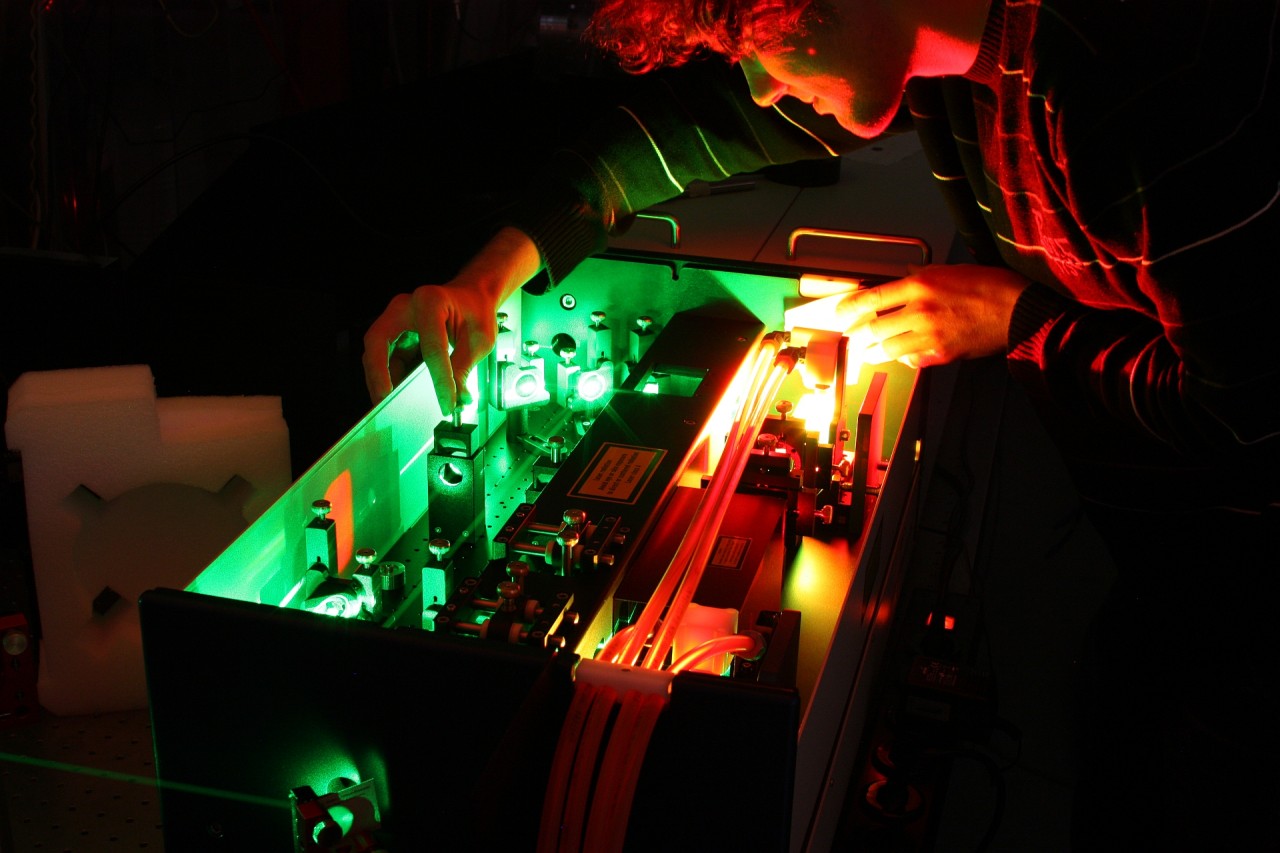
Tobias Thiele is tuning the dye laser. (Image: Stefan Filipp, Quantum Device Lab, ETH Zurich)
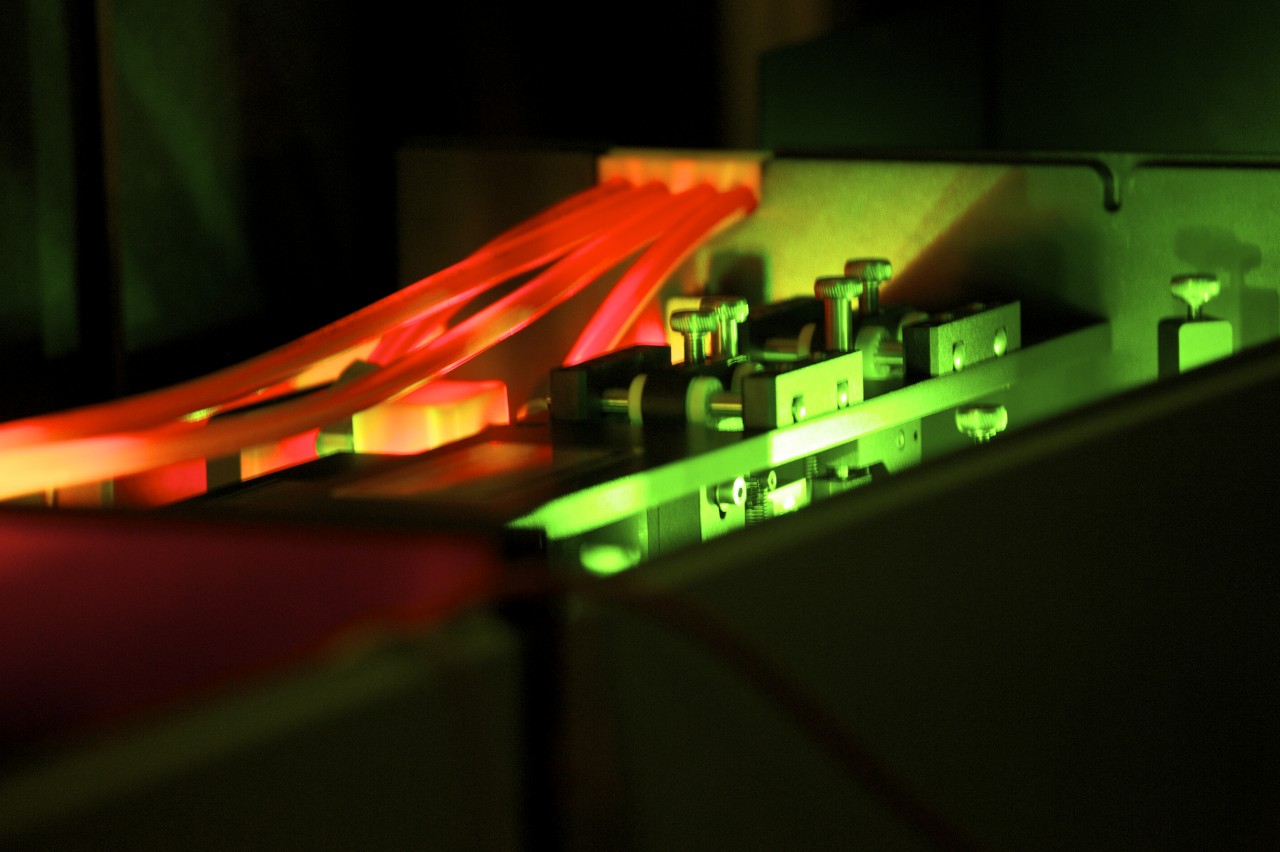
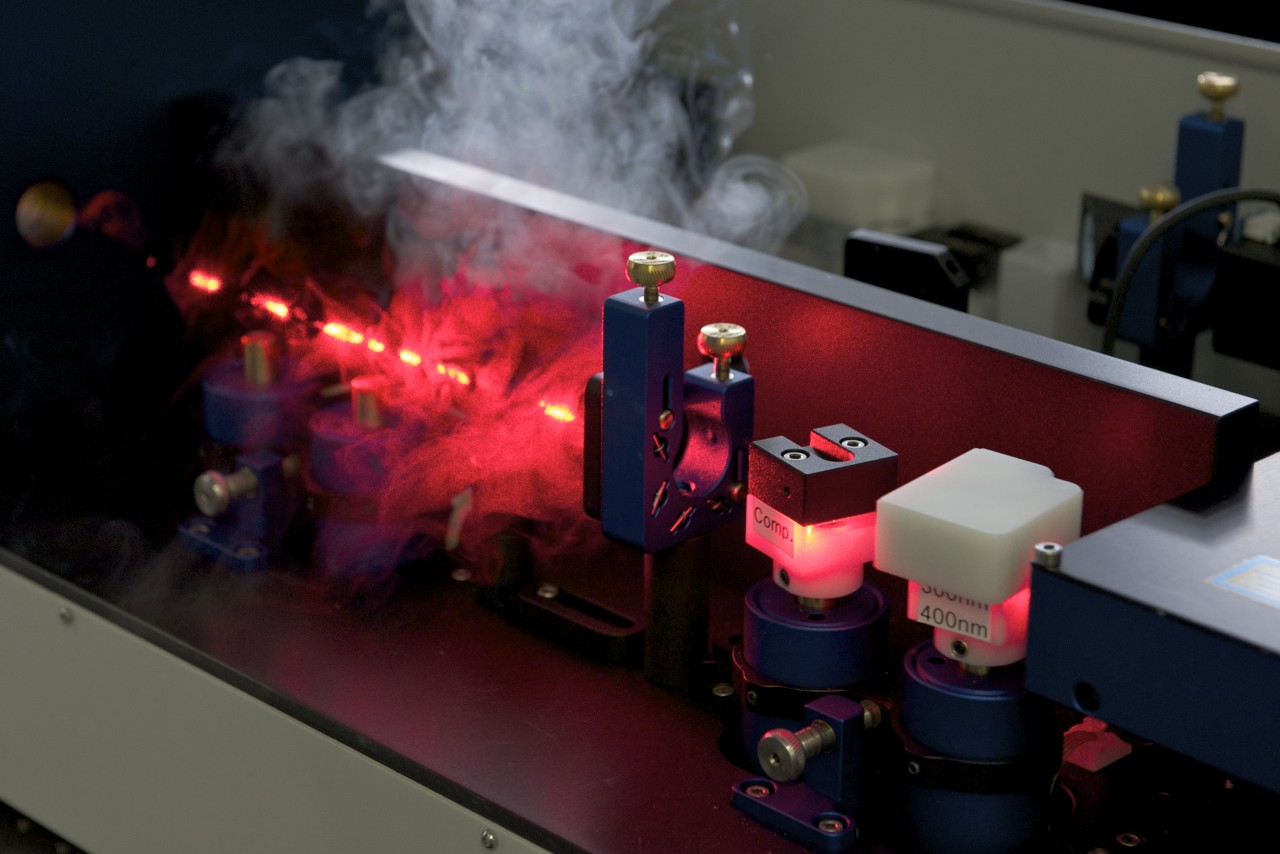
For hybrid quamtum experiments we use frequency tunable dye lasers to create atoms over a wide range of highly excited Rydberg states. (Image: Heidi Hostettler, ETH Zurich)
We frequency double visible laser light to obtain coherent radiation in the ultraviolet regime to excite Rydberg helium atoms. (Image: Heidi Hostettler, ETH Zurich)
A cold RF plasma discharge creates helium atoms in the metastable triplet state to lock a fiber laser onto its cycling transition. (Image: Heidi Hostettler, ETH Zurich)
Photograph of a transmission line on a chip used to interface Rydberg atoms with microwave photons. (Image: Heidi Hostettler, ETH Zurich)
Chip with six high-quality resonators in a copper cavity (Image: Jean-Claude Besse, Quantum Device Lab, ETH Zurich)
8-qubit Quantum Processor enabling the multiplexed readout using a single detection channel. (Image: Christian K. Andersen, Sebastian Krinner, Johannes Heinsoo, Christopher Eichler, Quantum Device Lab, ETH Zurich)
Lumped Element Resonator Array. (Image: Anton Potočnik, Quantum Device Lab, ETH Zurich)
SEM picture of our typical Josephson junctions to form a qubit (Image: Jean-Claude Besse, Quantum Device Lab, ETH Zurich)
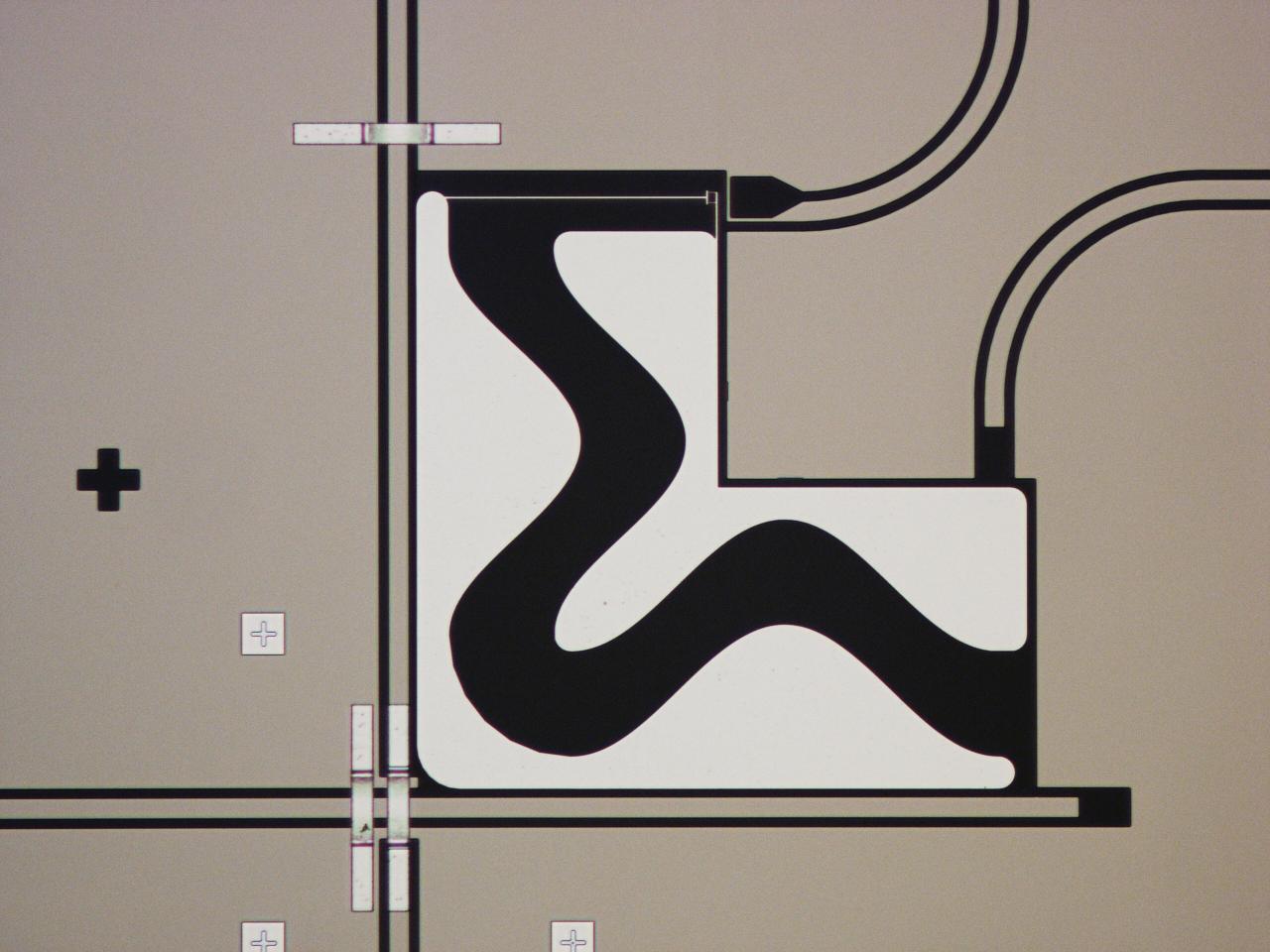
Closeup of a chip on the PCB. The groundplanes on the chip are bonded to the PCB with small wires, and the various groundplanes on the chip are similarly bonded to each other. The meandering line is the transmission line. Also visible are 3 fluxlines, going to the 3 qubits.  (Image: Arjan van Loo, Quantum Device Lab, ETH Zurich)
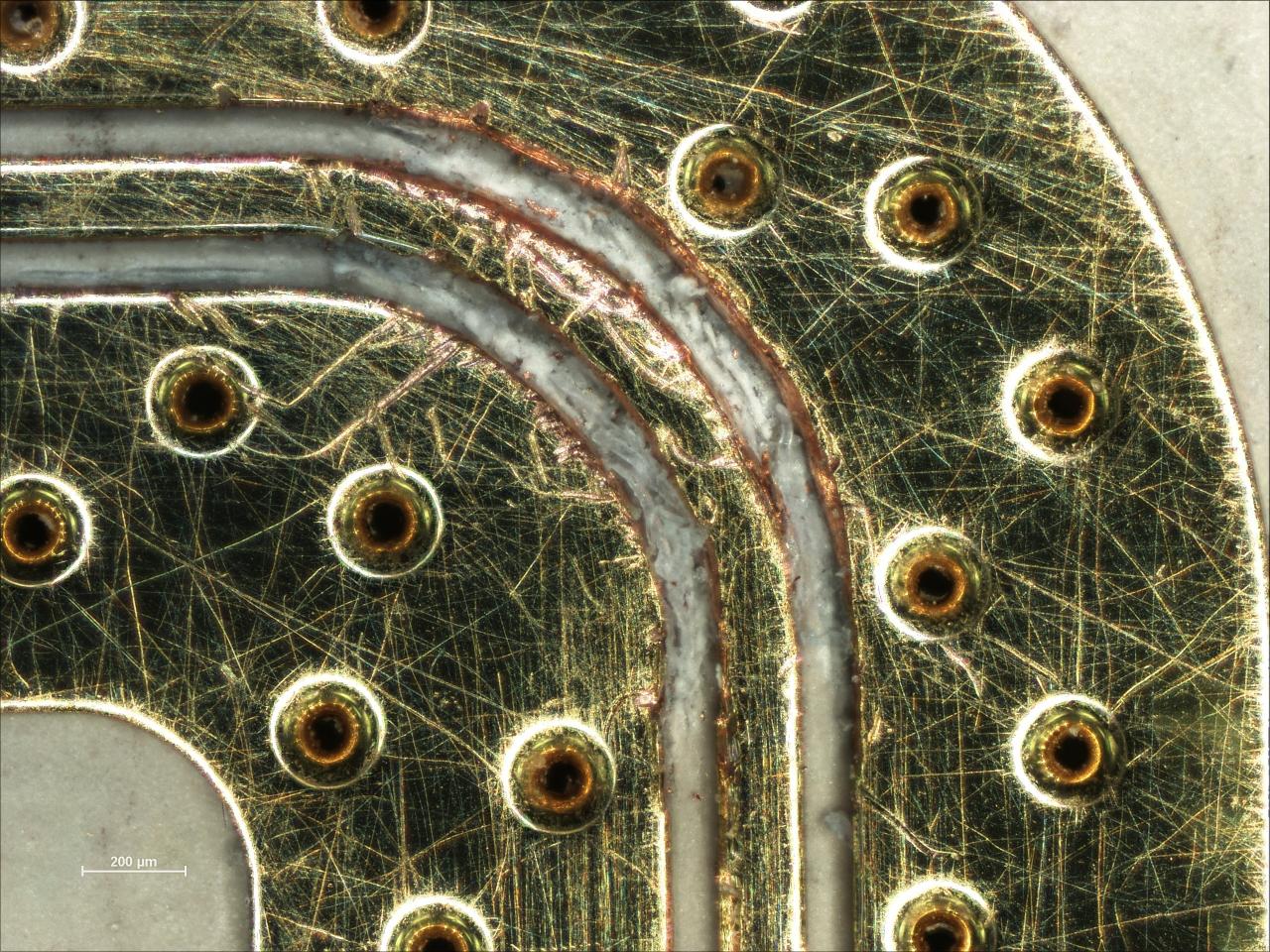
A gold plated coplanar microwave PCB form a commercial supplier. Dark field microscopy increases the contrast of the surface structure. (Image: Lars Steffen, Quantum Device Lab, ETH Zurich)
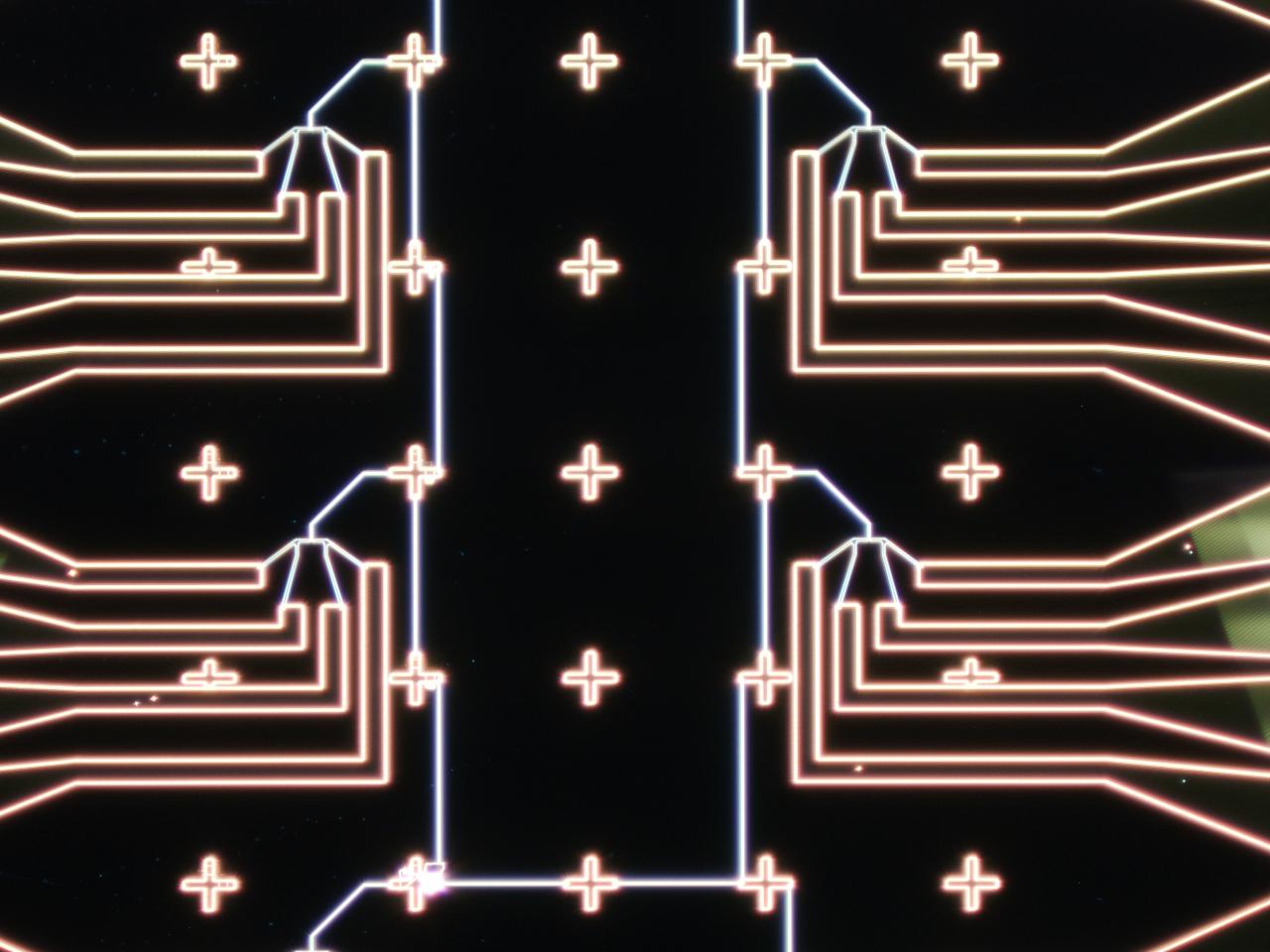
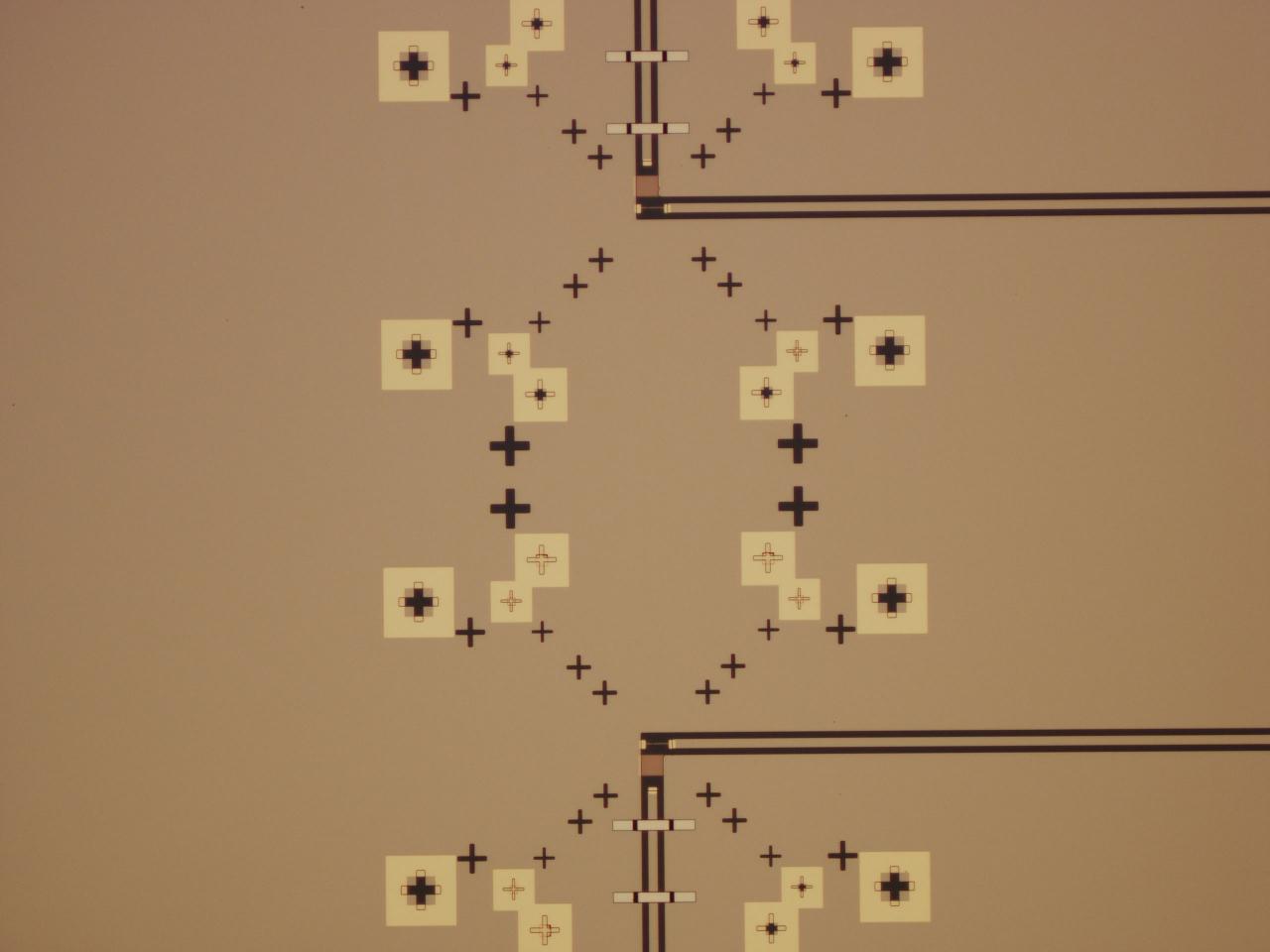
Dark field image of four break junction sites. White lines are electron beam lithography, yellow photolithography. Each site has four electrodes for resistance measurement and a gate, which is common to all sites. (Image: Gabriel Puebla, Quantum Device Lab, ETH Zurich)
A gated break junction after electrostatic discharge, vaporizing junction and gate. (Image: Gabriel Puebla, Quantum Device Lab, ETH Zurich)
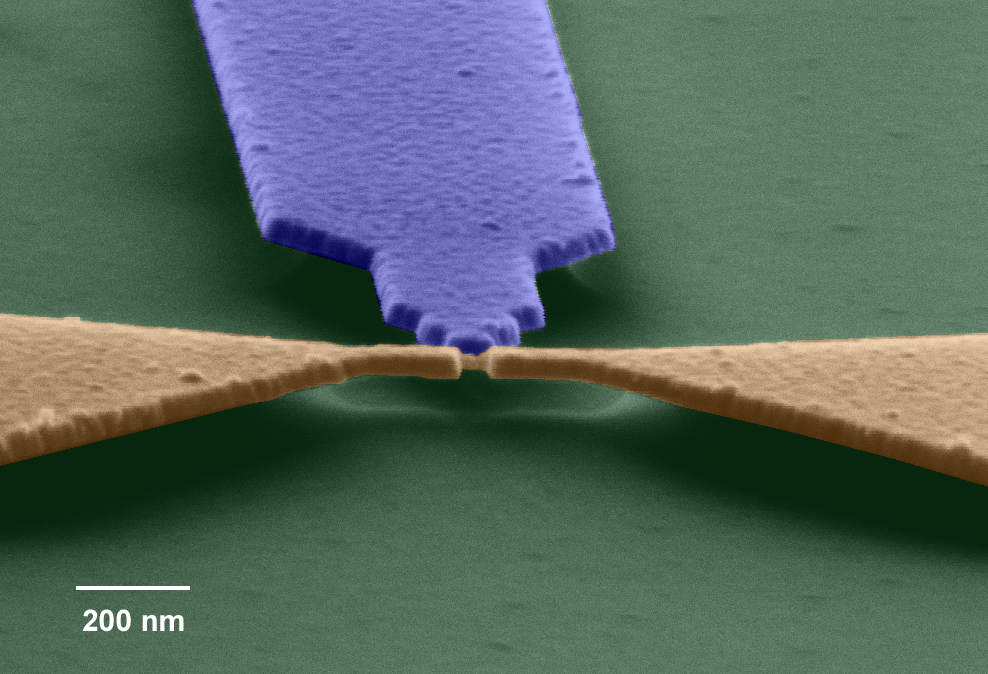
False-color SEM image of a gated break junction. The junction, shown in gold and the gate, shown in blue, sit on an etched silicon/silicon oxide wafer (green). (Image: Gabriel Puebla, Quantum Device Lab, ETH Zurich)
False-color SEM image of an electro-migrated break-junction. The induced gap can be seen but is actually on the order of 1 nm and not, as expected from the image, on the order of 5 nm. (Image: Gabriel Puebla, Quantum Device Lab, ETH Zurich)
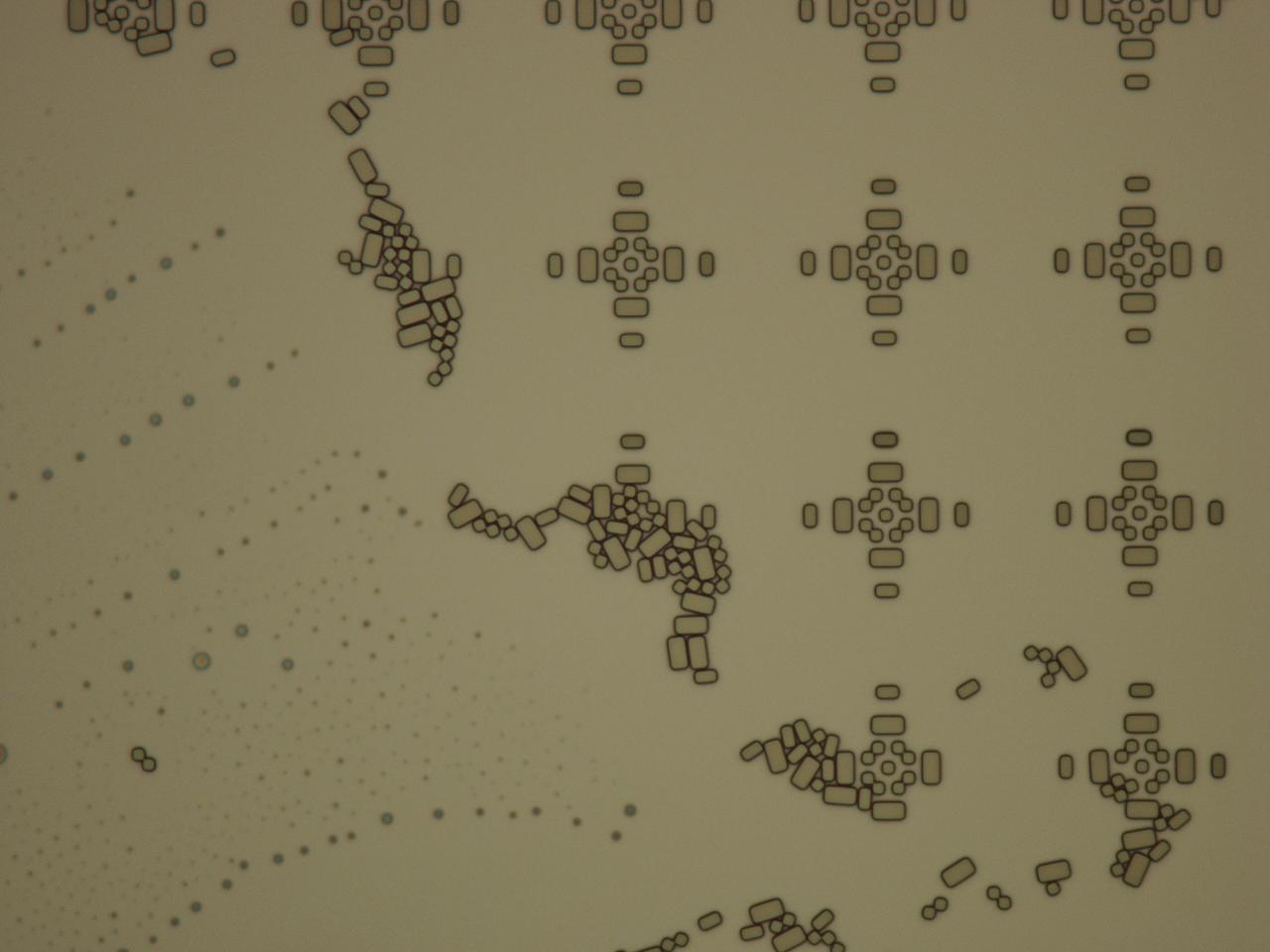
After the development process of photolithography, some parts of the structure (alignment marks) did not stick well enough to the substrate and were floating around. (Image: Lars Steffen, Quantum Device Lab, ETH Zurich)
Optical image an RF break junction chip. A break junction is placed at the end of a transmission line based device, in this case two such sites are faintly visible. (Image: Gabriel Puebla, Quantum Device Lab, ETH Zurich )
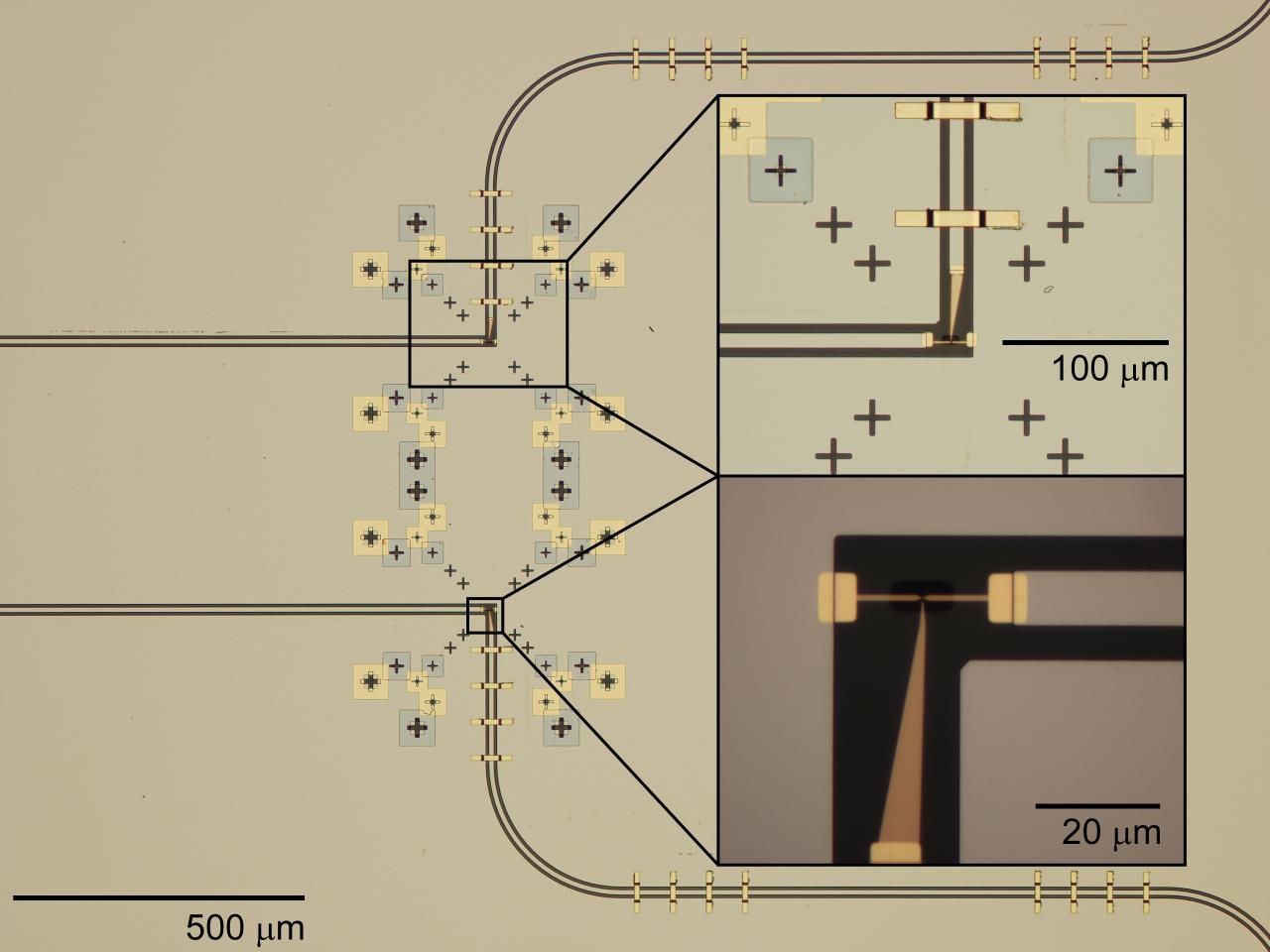
Optical image with several zooms of gated break-junctions integrated into coplanar waveguide matching circuits.( Image: Gabriel Puebla, Quantum Device Lab, ETH Zurich )
Optical-microscope image of a superconducting quantum bit and its microwave-frequency control circuit. These micro-scale electronic circuits are versatile building blocks for future quantum information processors. (Image: Arkady Fedorov, Quantum Device Lab, ETH Zurich)
The electron-microscope image of an ant gives a size reference for a superconducting quantum bit and its control circuit. (Image: Jonas Mlynek, Quantum Device Lab, ETH Zurich)
Arranging 17 qubits (in yellow) in a structure as indicated in this picture enables the implementation of an error correcting surface code of distance three. The dimensions are 14.3 mm by 14.3 mm. (Image: Quantum Device Lab, ETH Zurich)
A 17-qubit device, inside its PCB, at the wirebonding station. (Image: Jean-Claude Besse, Quantum Device  Lab, ETH Zurich)
The 17-qubit chip inside of this sample holder is controlled using a multitude of signal lines. (Image: Quantum Device Lab, ETH Zurich)
The side view of this mounted 17-qubit chip reveals the cabling arrangement inside of the cryostat. (Image: Quantum Device Lab, ETH Zurich)
Bottom view of the rack on the inside of a cryostat with a 17-qubit chip installed. (Image: Quantum Device Lab, ETH Zurich)
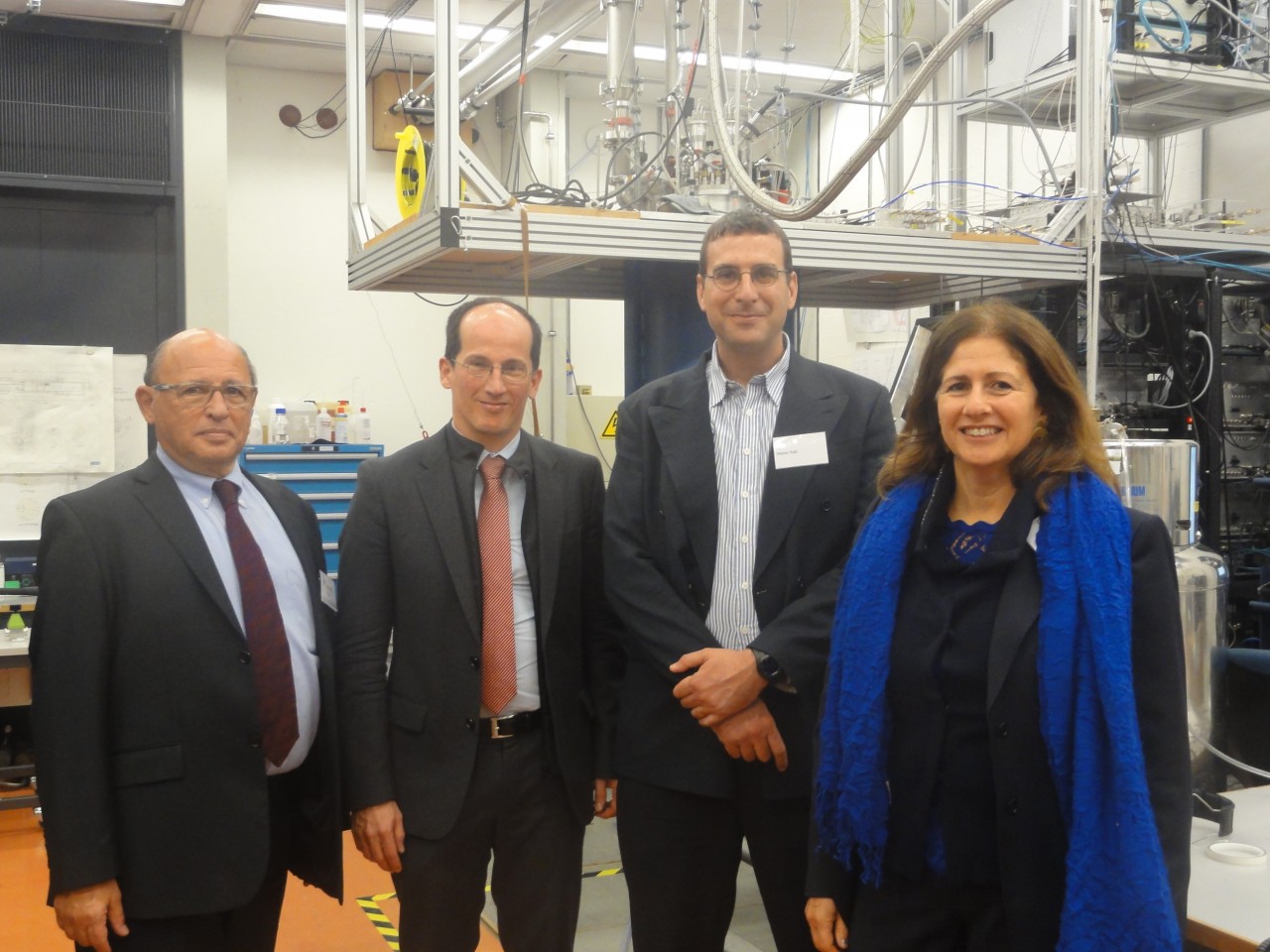
HUJI & ETHZ Workshop, group photo taken outside of the ETH faculty lounge.
HUJI & ETHZ Workshop, visit of the Quantum Device Lab.
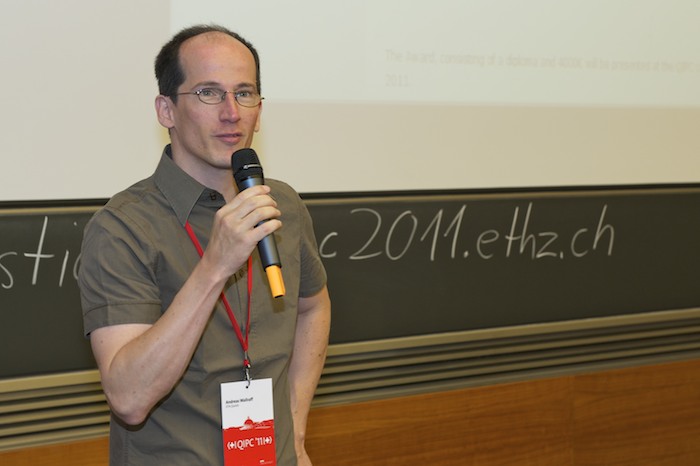
QIPC 2011, Young Investigator Award, Sept 6, 2011, Andreas Wallraff (Image: Heidi Hostettler, ETH Zurich)
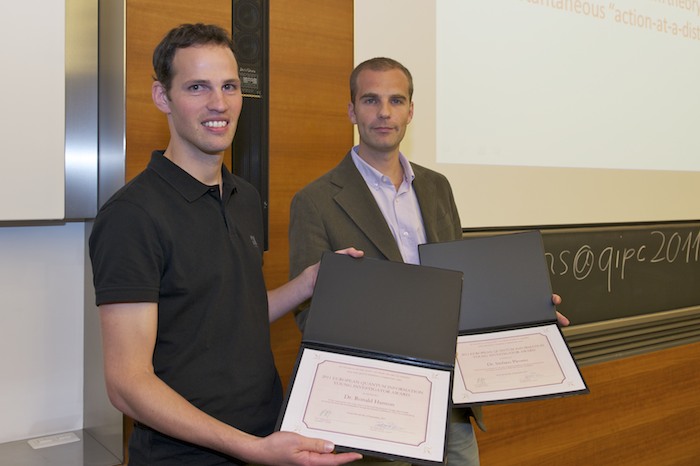
Ronald Hanson and Stefano Pironio (from left to right) were awarded the QIPC 2011 Young Investigator Award (Image: Heidi Hostettler, ETH Zurich)
QIPC 2011, Young Investigator Award, Sept 6, 2011, from left to right: Lukas Theussel, Nicolas Gisin, Roland Hanson, Stefano Pironio, Andreas Wallraff (Image: Heidi Hostettler, ETH Zurich)
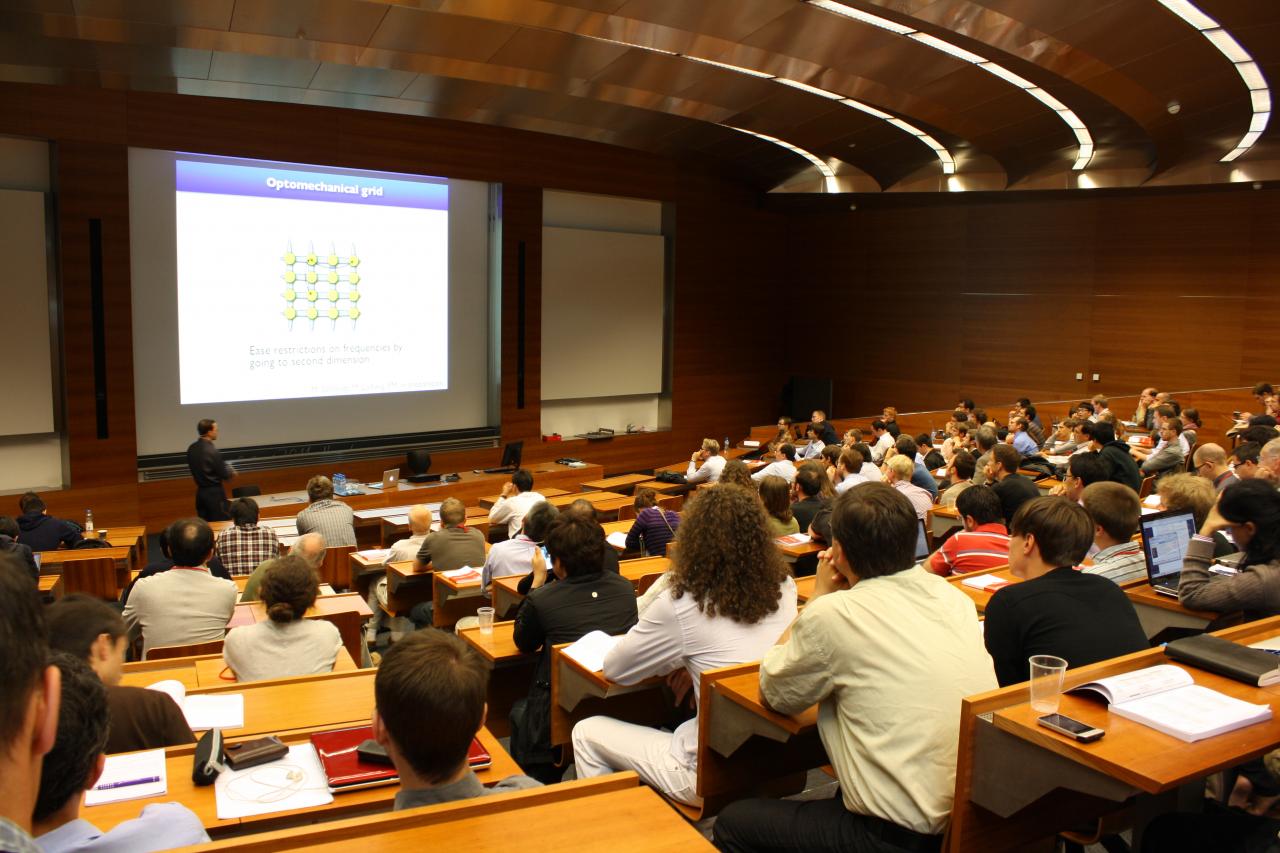
QIPC 2011 Conference (Image: Quantum Device Lab, ETH Zurich)
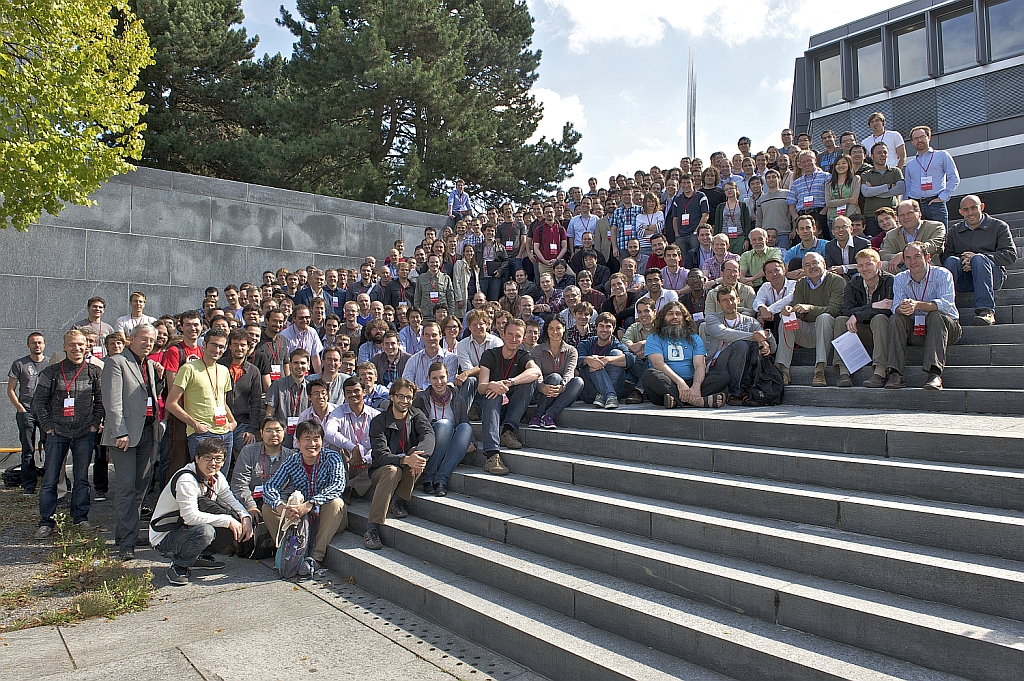
QIPC 2011 Conference, group photo (Image: Heidi Hostettler, ETH Zurich)
QIPC 2011 School, group photo taken on Sept 2, 2011
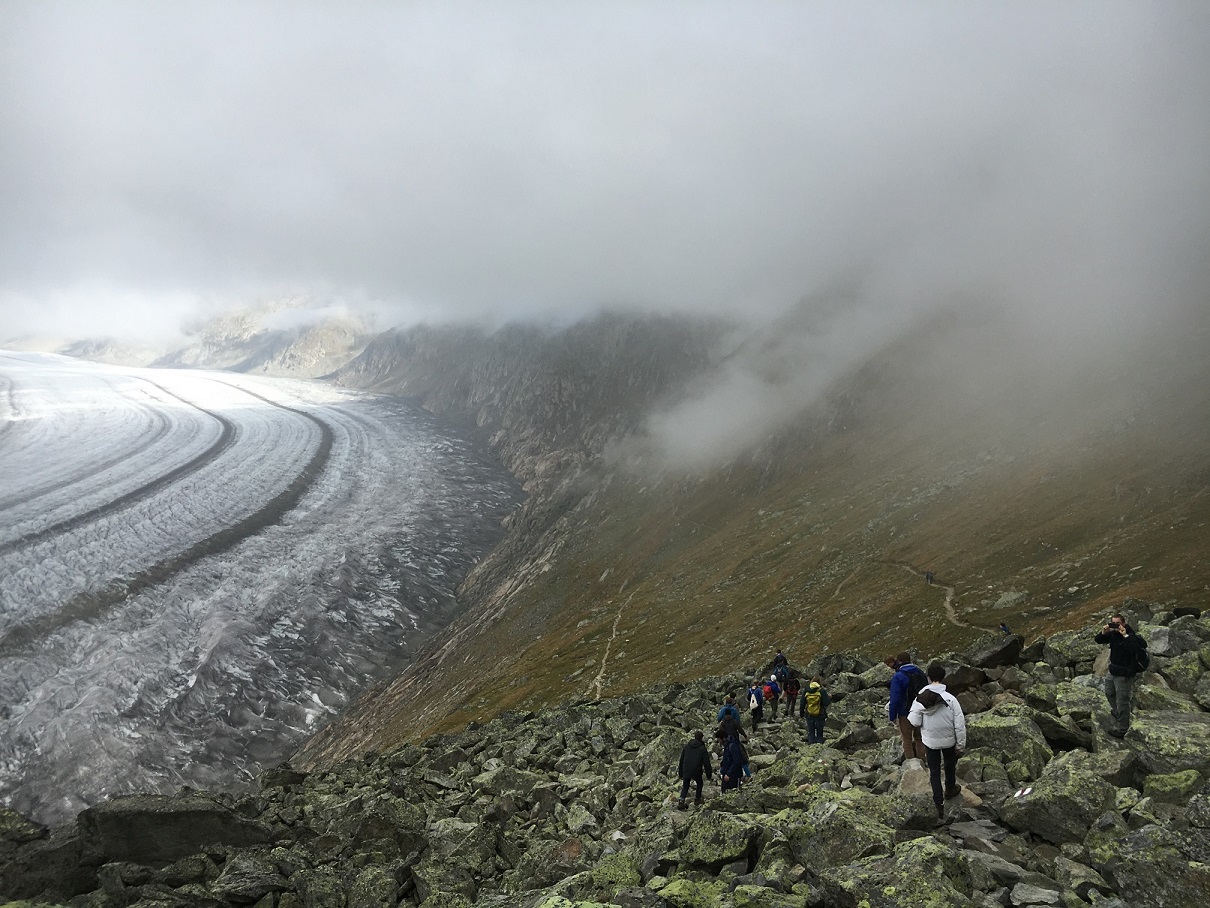
QIPC 2011 School, hike to Pers glacier on Sept 3, 2011
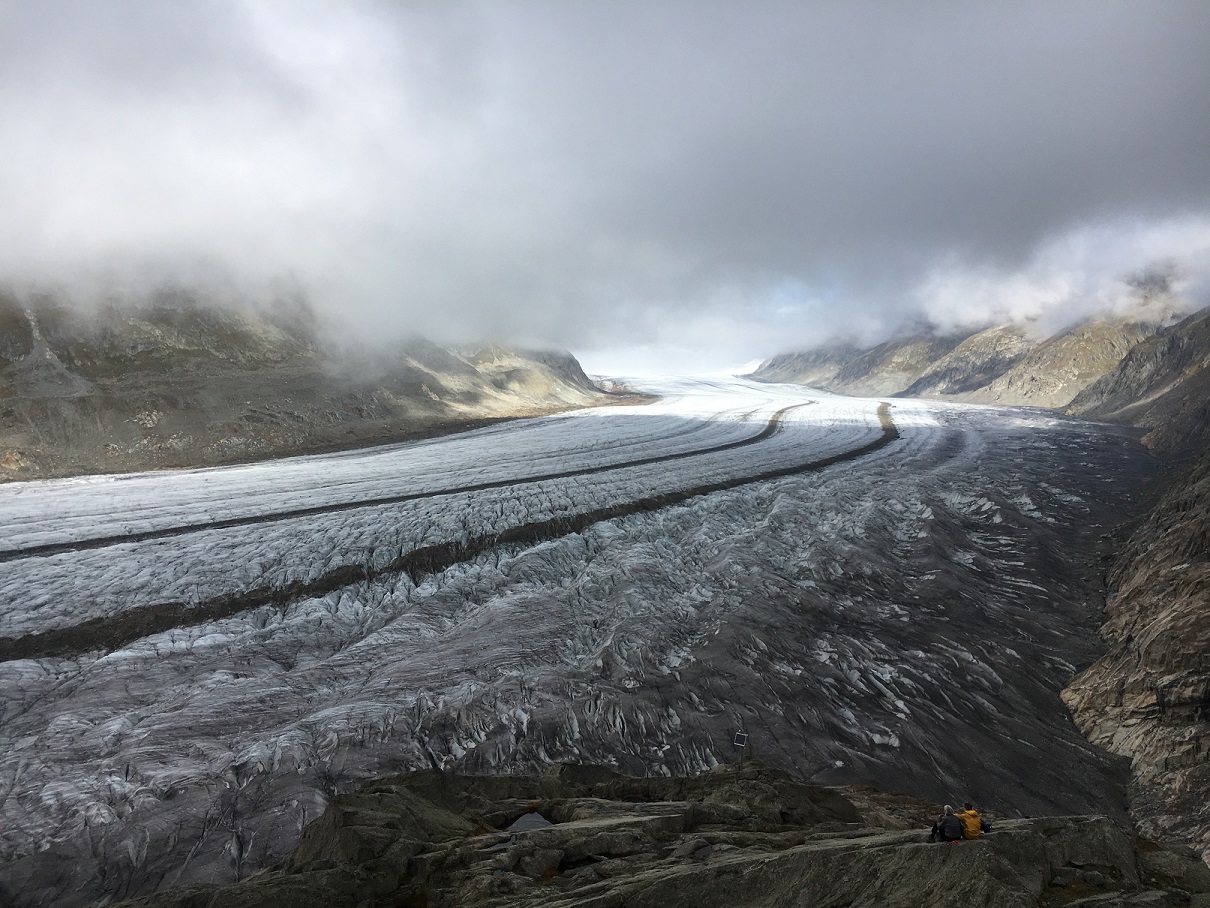
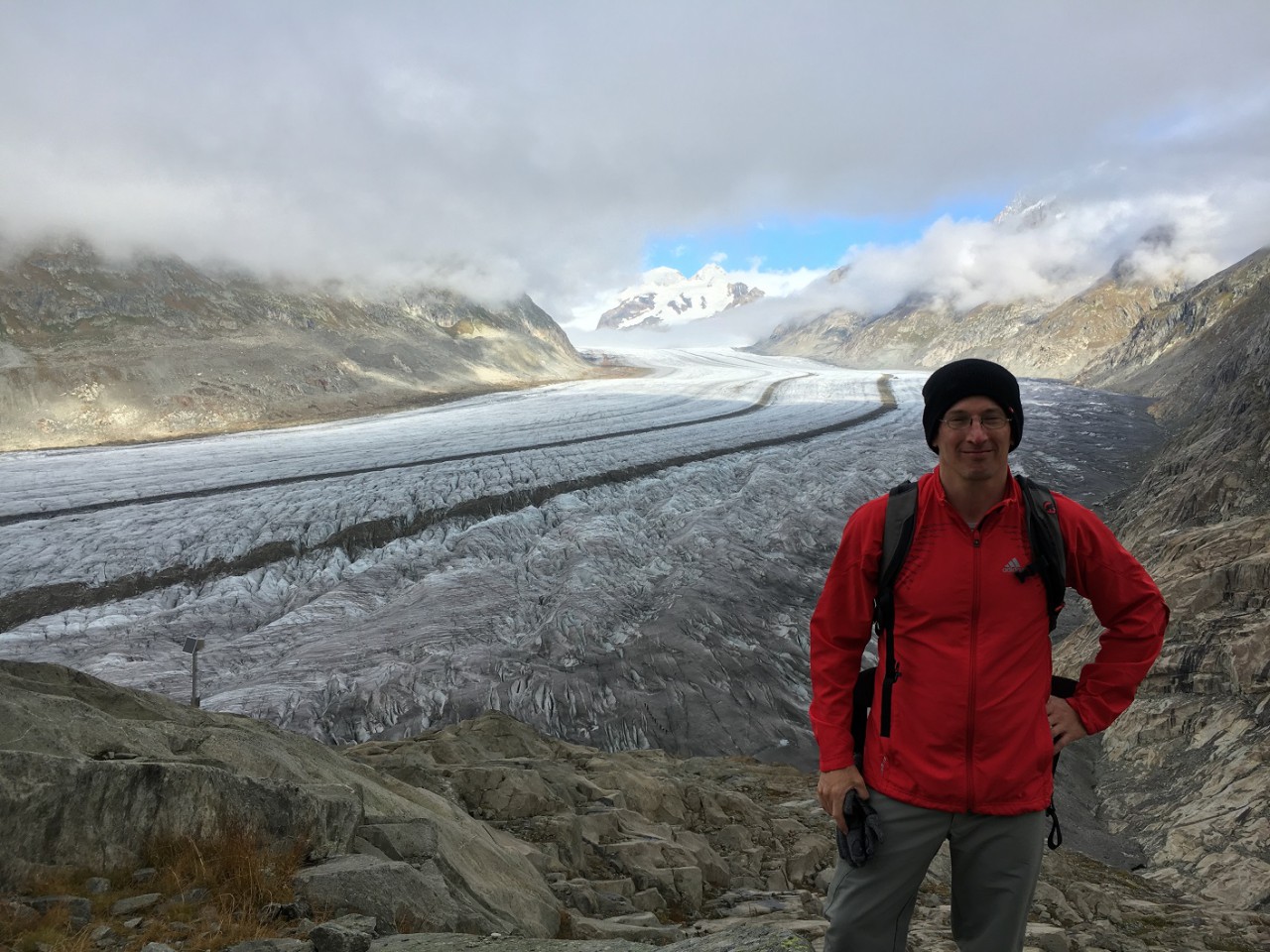
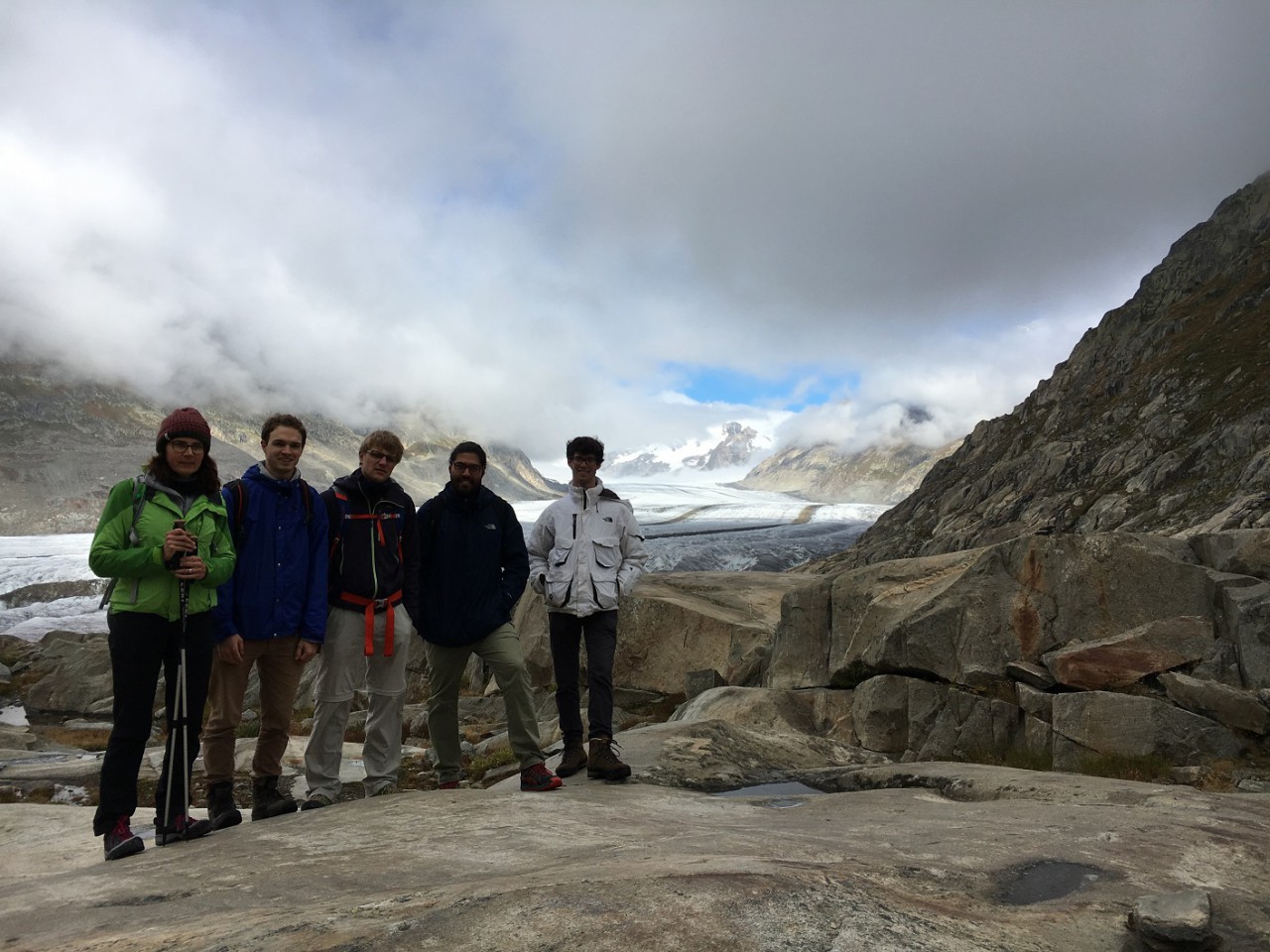
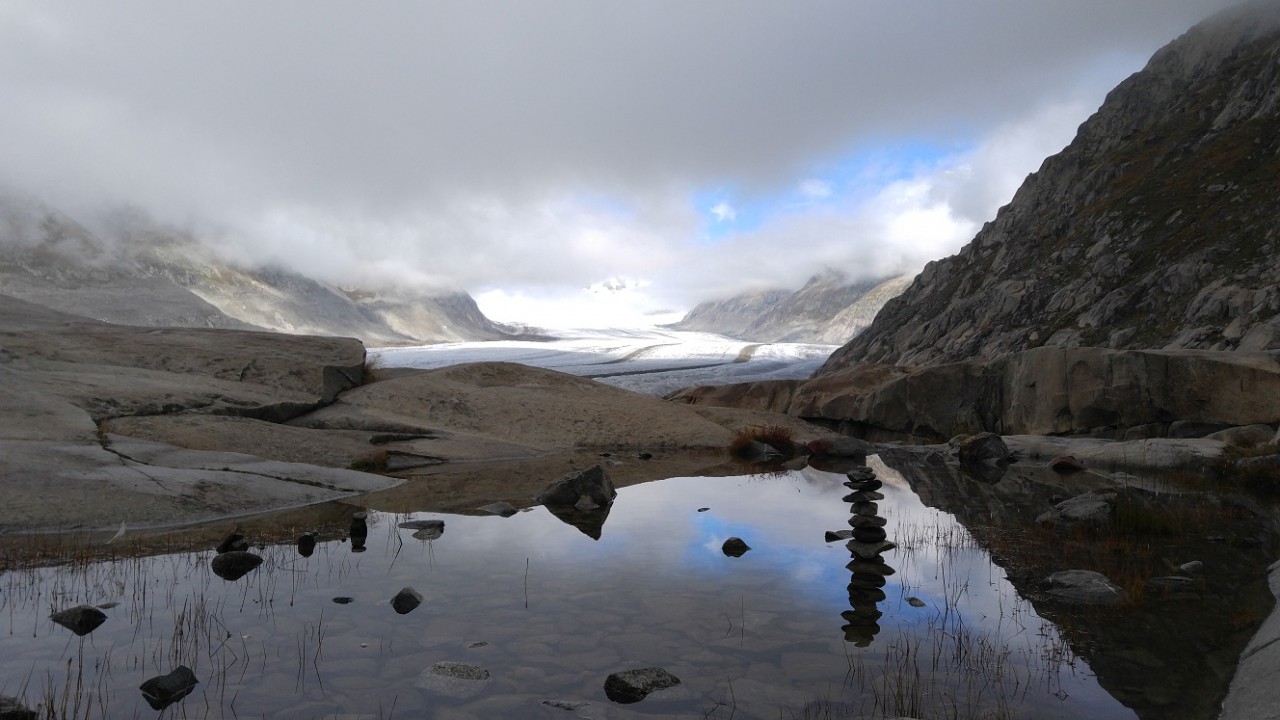
Hiking Tour Aletsch Glacier
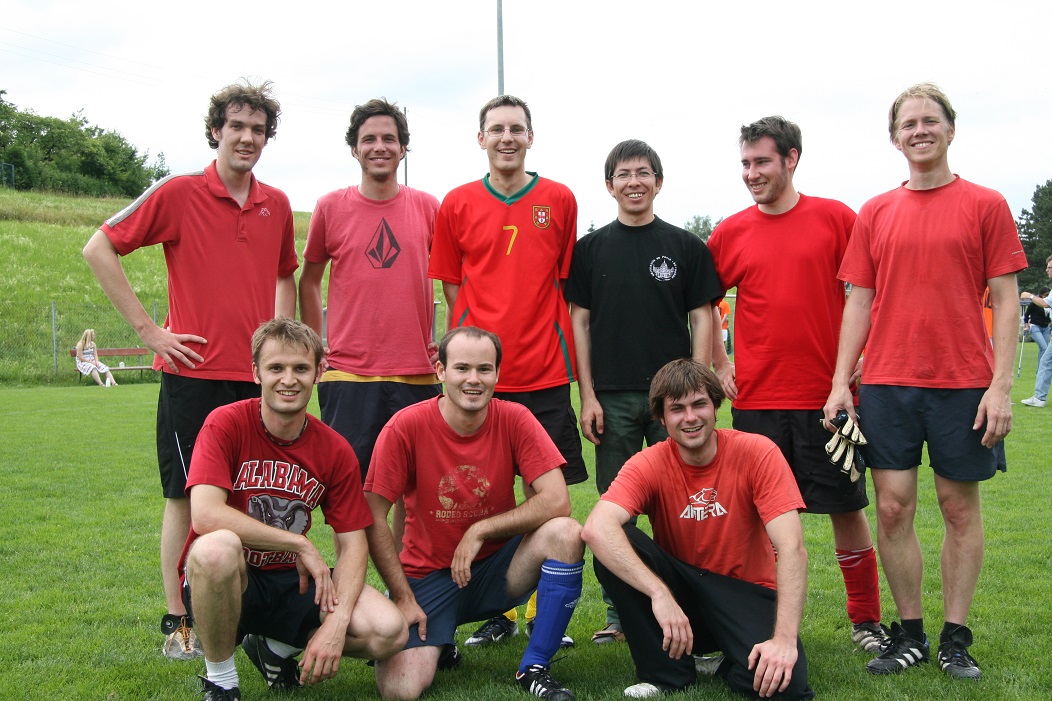
AMP Boltzmann Cup 2011
AMP Boltzmann Cup 2013
AMP Boltzmann Cup 2014
AMP Boltzmann Cup 2015
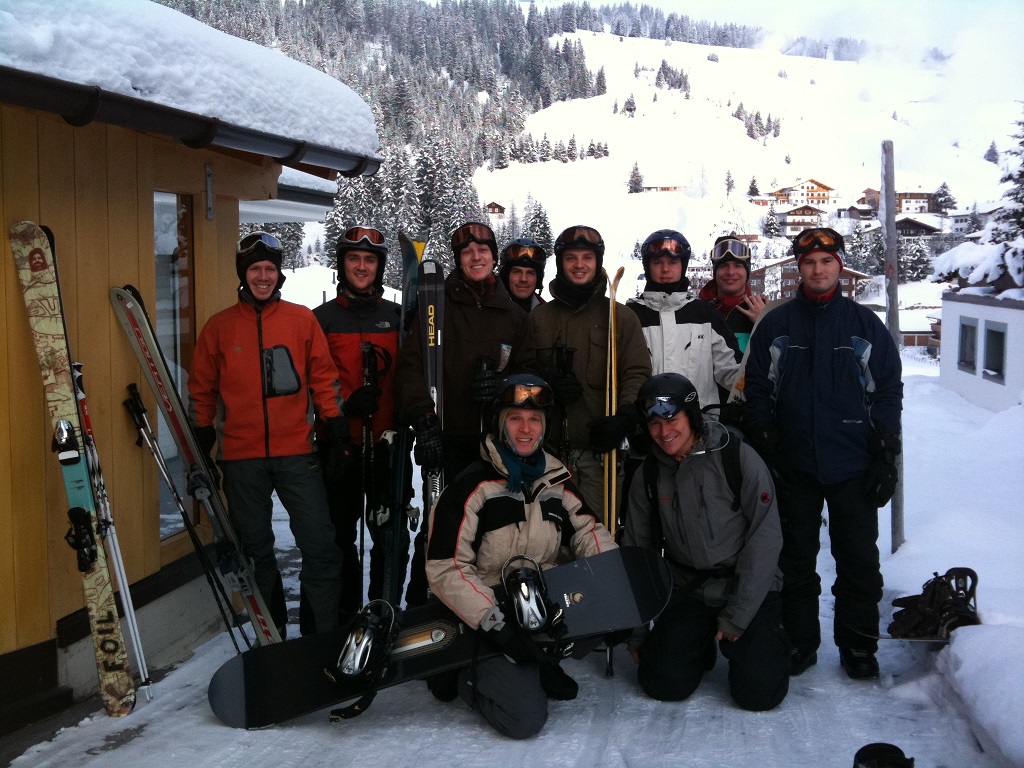
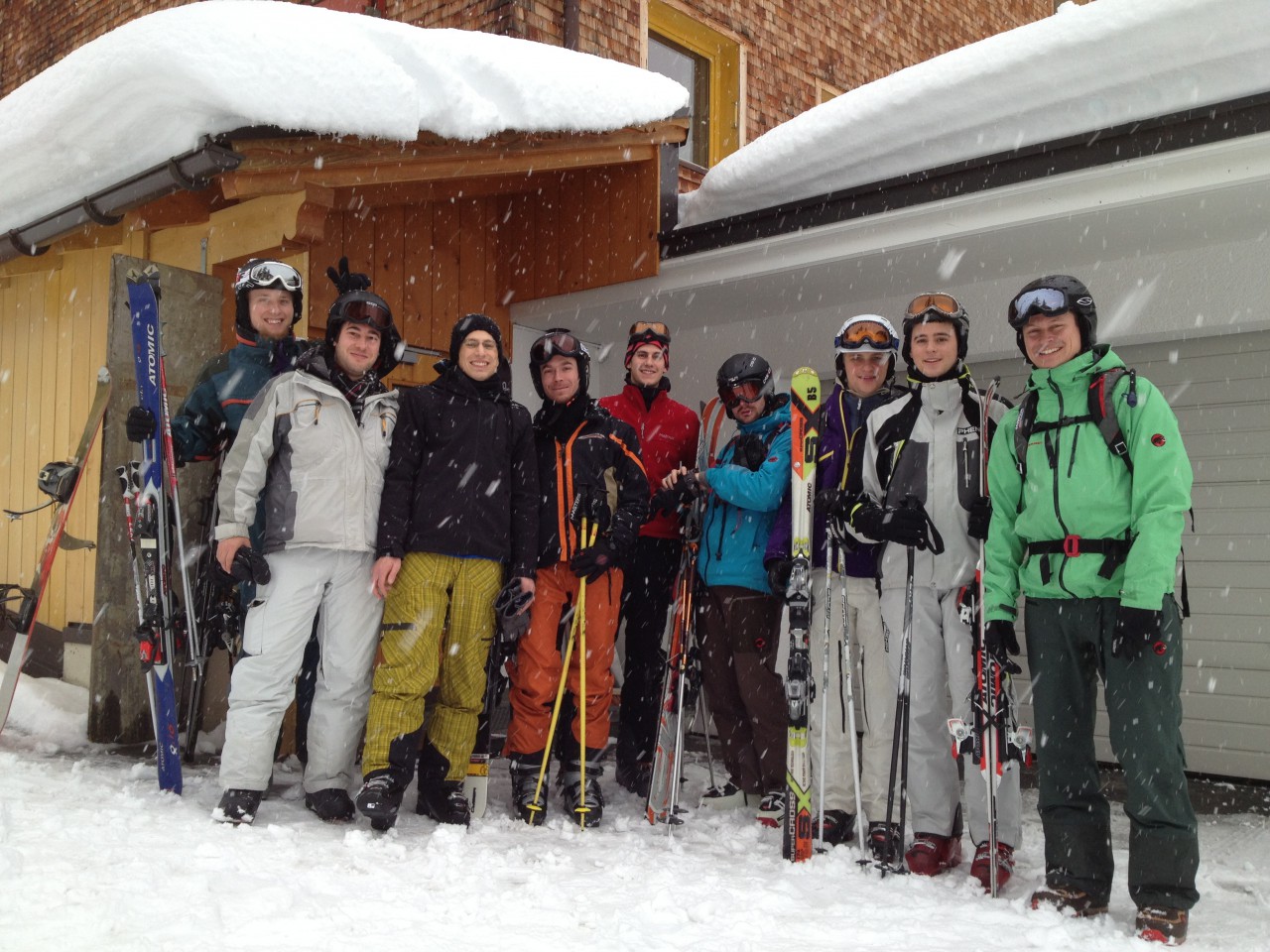
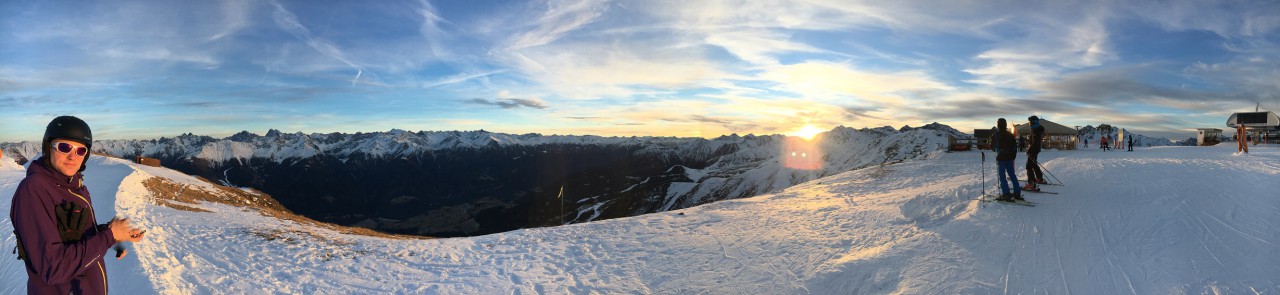
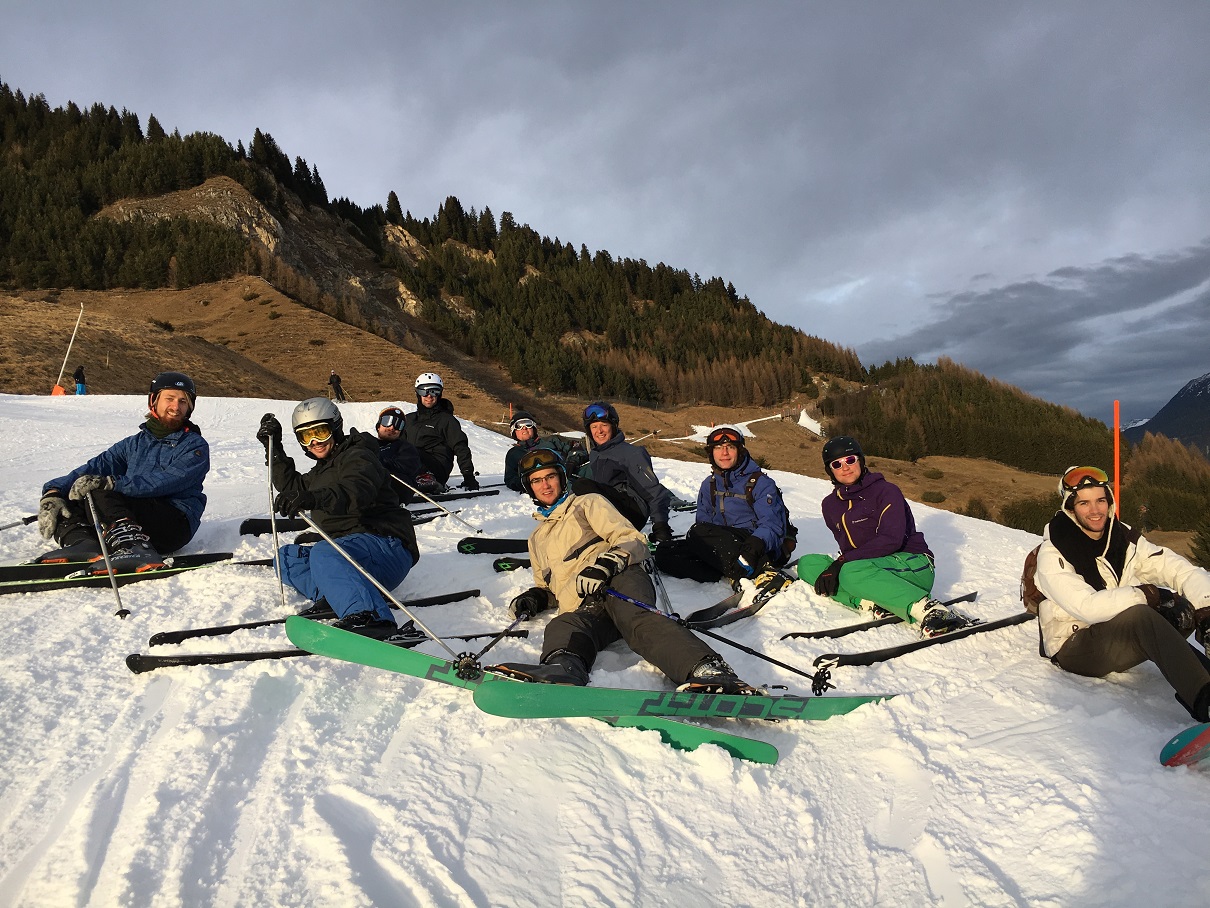
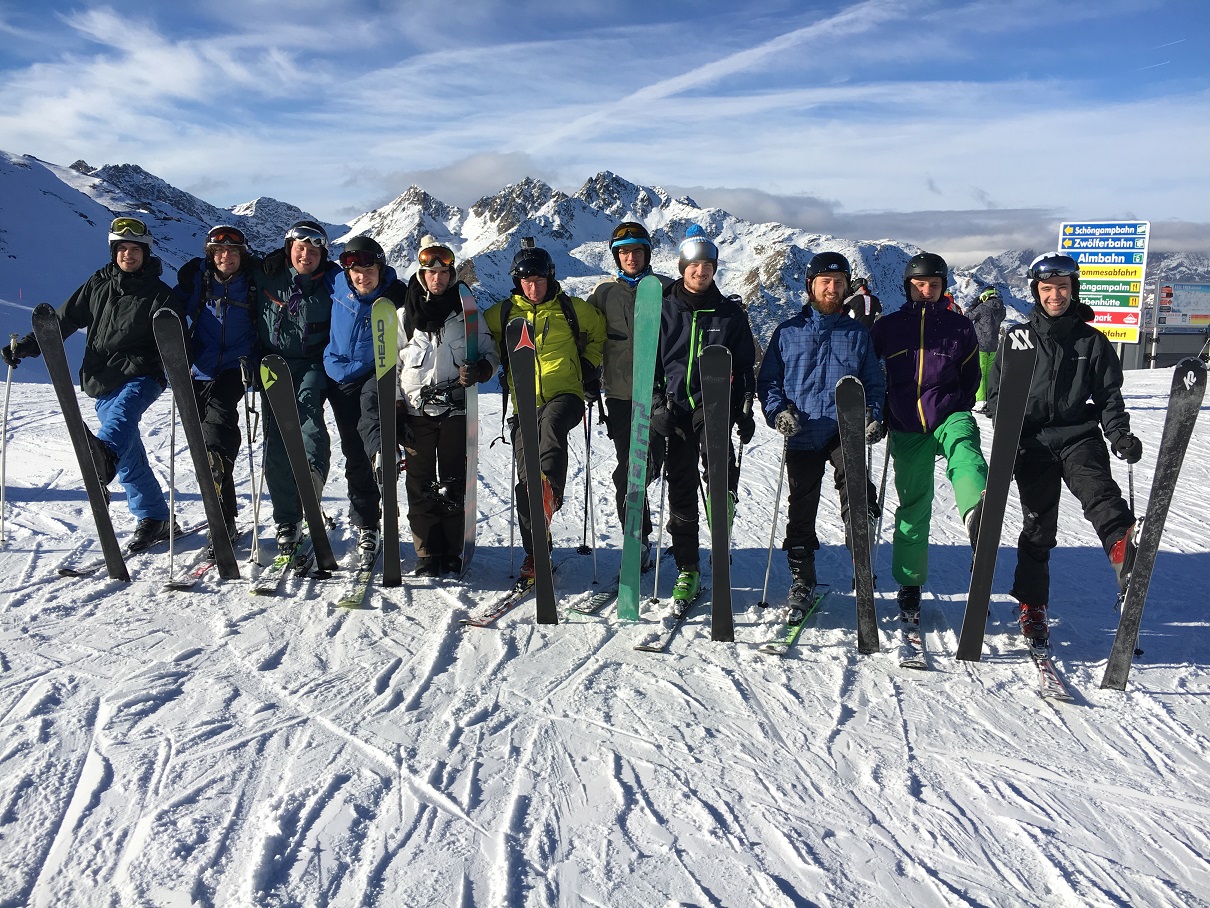
QuDev Skiing 2009 in Lech
QuDev Skiing 2010 in Lech
QuDev Skiing 2011 in Ischgl
QuDev Skiing 2012 in Lech
QuDev Skiing 2016 in Ladis
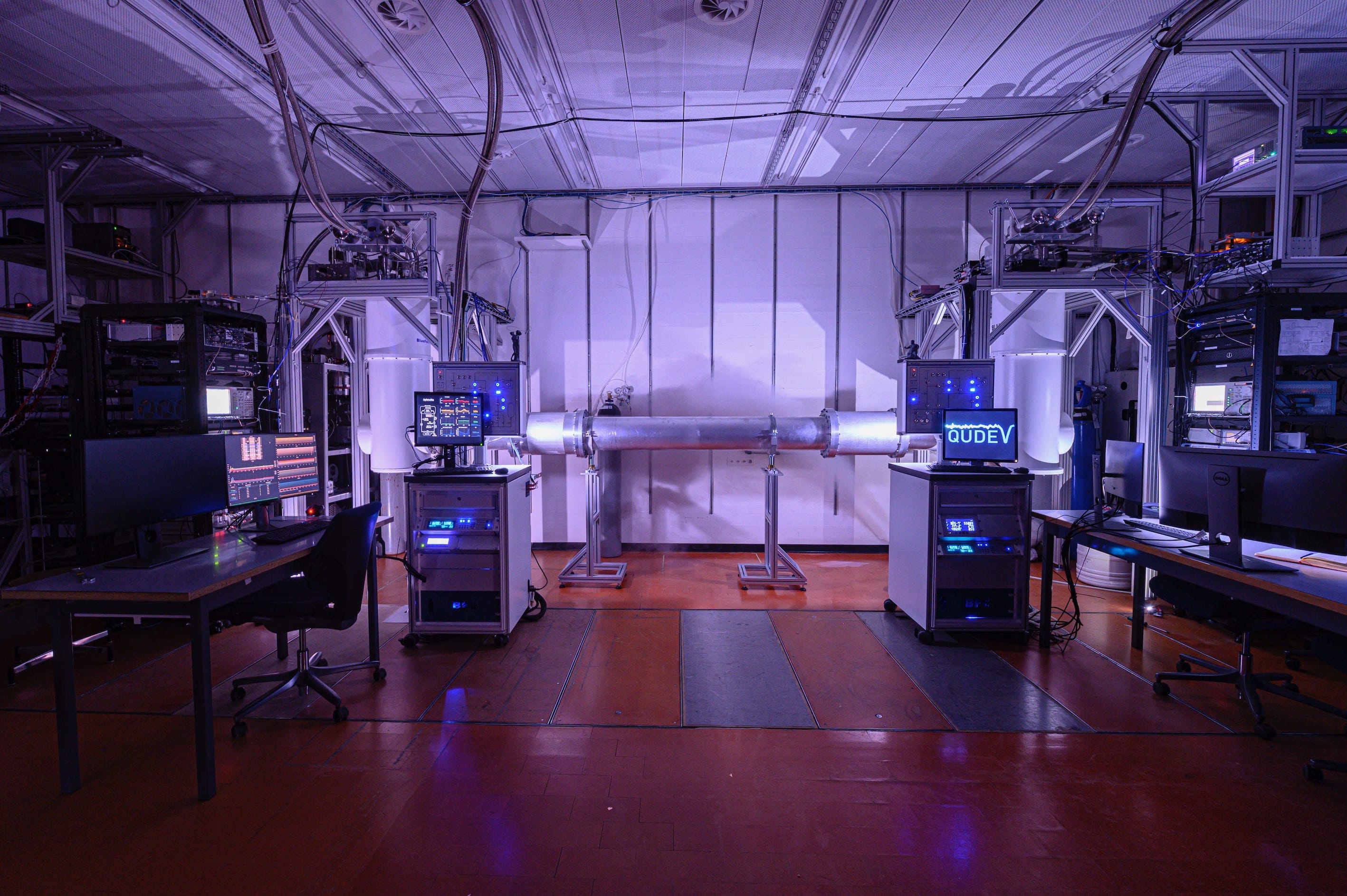
SuperQuNet 2020: Cryogenic link between two cryostats in the Cryogenic Lab at Hönggerberg. (Image: Heidi Hofstetter, ETH Zürich)
SuperQuNet 2022: Cryogenic link laboratory of the Quantum Device Lab on the ETHZ campus at Hönggerberg. (Image: Simon Storz, Quantum Device Lab, ETH Zürich)
SuperQuNet 2022: 4K cryostat in the center of the 30 meter long cryogenic link, providing extra cooling power on the 50K and 4K temperature stages. (Image: Simon Storz, Quantum Device Lab, ETH Zürich)
SuperQuNet 2022: Side view of the 30 meter long cryogenic link with the central 4K cryostat in the middle of the picture. (Image: Simon Storz, Quantum Device Lab, ETH Zürich)
SuperQuNet 2022: 30 meter long cryogenic quantum link between two dilution refrigerators. One of the dilution refrigerators is seen in the back. (Image: Simon Storz, Quantum Device Lab, ETH Zürich)
SuperQuNet 2022: View through the vacuum can of the cryogenic link (without radiation shields and waveguide), and a dilution refrigerator in the back. (Image: Simon Storz, Quantum Device Lab, ETH Zürich)
SuperQuNet 2022: One of the dilution refrigerators connected to a 30 meter long cryogenic link. The rack in the foreground houses the electronics used to control and read out the state of a qubit. (Image: Simon Storz, Quantum Device Lab, ETH Zürich)
SuperQuNet 2022: Cross section of the radiation shields of a cryogenic quantum link with a waveguide in the center, and a dilution refrigerator in the back. (Image: Simon Storz, Quantum Device Lab, ETH Zürich)
SuperQuNet 2022: Connection of two cryogenic link modules with flexible copper braids. (Image: Simon Storz, Quantum Device Lab, ETH Zürich)
SuperQuNet 2022: Look inside the central 4K cryostat with different layers of radiation shields. (Image: Simon Storz, Quantum Device Lab, ETH Zürich)
SuperQuNet 2022: Part of the 30 meter long cryogenic link with laser beams used to align different modules to each other. (Image: Simon Storz, Quantum Device Lab, ETH Zürich)
Tags:
Date Range:

News

New quantum computing project launched (2023-11-01) [...]
Loophole-free Bell inequality violation with superconducting circuits (2023-05-10) [...]
Repeated quantum error correction in a distance-three surface code (2022-05-25) [...]
ETH Zurich and PSI found Quantum Computing Hub (2021-05-03) [...]
Website 2015-2024 Website 2008-2015 Login Wiki Database Reservation
Follow @QuDev
Facebook Logo
Copyright © 2006-2025 Quantum Device Lab at ETH Zurich. All rights reserved.