


Generating unbiased random numbers is critical for high-security fields like cryptography, yet it has remained impossible using conventional methods. In our latest Nature publication, we mark a major milestone by demonstrating the first experiment capable of producing certifiably perfect random numbers. To achieve this, the Wallraff group—with corresponding author Anatoly Kulikov—collaborated with Professor Renato Renner’s group to pair a highly optimized experimental setup with theoretical advances. By utilizing entangled superconducting qubits and a Bell test, the team successfully transformed imperfect randomness into perfect random numbers. This process, known as randomness amplification, is uniquely possible through quantum technology, overcoming the limitations of classical information processing.

Achieving certifiably perfect randomness with quantum technology

Nathan Lacroix wins Division of Quantum Information Thesis Award of the American Physical Society
We are proud to announce that Nathan Lacroix from our Quantum Device Lab and the Quantum Center won the Division of Quantum Information (DQI) Thesis Award of the American Physical Society! Nathan concluded his thesis on “Quantum Error Correction with Superconducting Circuits” in 2025 and now works at Google Quantum AI. The award recognizes doctoral thesis research of outstanding quality in quantum information science and technology, and encourages effective presentation of research results. Congratulations Nathan! Picture credits: ETH Zurich/Daniel Winkler

Functional building blocks for lattice-surgery on superconducting qubits
Innovative solutions for quantum error correction are needed to implement quantum computing, which requires the use of hundreds of logical qubits in a fault-tolerant manner. Researchers from our group, in collaboration with the theory team of Professor Markus Müller at RWTH Aachen University and Forschungszentrum Jülich, have now demonstrated a technique that makes it possible to perform a quantum operation between superconducting logical qubits while correcting for potential errors occurring during the operation. The results were just published in Nature Physics. This demonstration of lattice surgery on superconducting qubits marks an important step towards the ambitious goal of building useful quantum computers.

New publication in Physical Review Research
Check out our latest publication on Experimentally informed decoding of stabilizer codes based on syndrome correlations, just published in Physical Review Research.

New quantum computing project launched
The Quantum Device Lab has been granted the project SuperMOOSE by IARPA, the US research funding agency. Coordinated by our group, the project aims to establish a connection between two error-corrected qubits, laying the foundation for future quantum computers. Our team collaborates with researchers from MIT, Forschungszentrum Jülich, Université de Sherbrooke in Canada and two industry partners, Zurich Instruments and Atlantic Quantum.

Loophole-free Bell inequality violation with superconducting circuits
Researchers from our group have demonstrated that superconducting circuits separated by a cryogenic link spanning a distance of 30 metres can be much more strongly correlated with each other than is possible classically. This loophole-free Bell test firmly establishes non-locality is a resource in quantum information technology based on superconducting circuits.

Repeated quantum error correction in a distance-three surface code
Operations on quantum computers, like on any technology, are inevitably subjected to errors, due to both external sources of interference and imperfections in their operation. But coping with quantum errors is particularly challenging. Writing in Nature, Sebastian Krinner and Nathan Lacroix, scientists at the Quantum Device Lab, together with their collaborators and working with colleagues in Canada and Germany, report a substantial advance towards fault-tolerant quantum computers. Using 17 physical qubits in a superconducting circuit, they demonstrate quantum error correction using the so-called surface code, which is known for its exceptionally high tolerance to errors.

ETH Zurich and PSI found Quantum Computing Hub
ETH Zurich and the Paul Scherrer Institute (PSI) establish a joint centre for the development of quantum computers. ETH Zurich provides 32 million francs for this centre, which will host around 30 researchers. Under the leadership of Andreas Wallraff and Jonathan Home they will pursue research in the two technology areas of superconducting circuits and ion traps. In the future, further groups working on related topics will complement the research centre. The Quantum Computing Hub will be located on the PSI campus in Villigen, Canton of Aargau. For this purpose, an existing building was converted specifically for research on quantum computers.
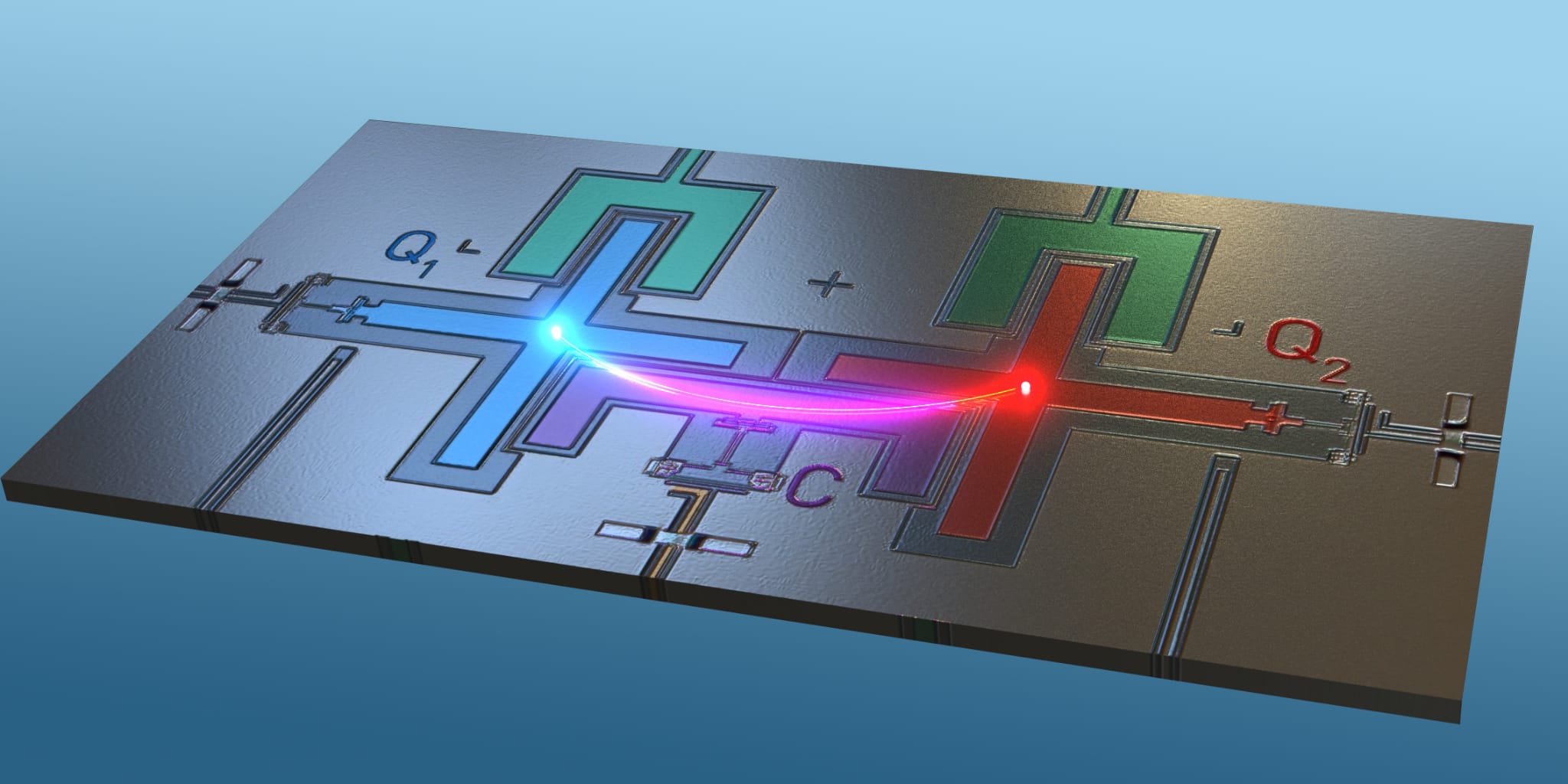
Implementation of Conditional Phase Gates Based on Tunable ZZ Interactions
Quantum computers, which have the capability to outperform classical computers on specific computational tasks, heavily rely on high-performance two-qubit gates for the realization of quantum algorithms. In superconducting circuits, two-qubit gates are typically based on a transversal qubit-qubit coupling, implemented either by rf-control or the in-situ frequency tunability of computational qubits.
In this work, we demonstrate a novel approach using a tunable cross-Kerr-type ZZ interaction between two qubits which we realize with a flux-tunable coupler element.
This approach ensures direct control of the acquired conditional phase, without relying on excitation transfer or sideband transitions, and thus features an inherent resilience to leakage and cross talk, both major concerns in the light of recent progress towards full-scale quantum error correction. Additionally it innately enables the realization of continuous gate sets, highly beneficial for near-term variational quantum algorithms. A simple control paradigm and robust performance ensure easy scalability and high compatibility with existing platforms.

Andreas Wallraff receives Helmholtz International Fellow Award 2020
Andreas Wallraff receives one of the 2020 Helmholtz International Fellow Awards of the Helmholtz Association of German Research Centres. The award serves also to expand an existing cooperation with scientists at the Forschungszentrum Jülich (Germany).