Research News

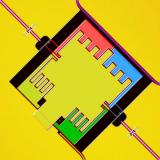
A hardware-efficient gate set for superconducting qubits is shown to improve the performance of deep quantum optimization algorithms.

Quantum computers have the potential to solve problems that today’s computers cannot solve in a reasonable amount of time. However, their computations are not yet reliable, meaning that algorithms with many operations cannot be executed without significant errors. This article presents a method to reduce these errors by reducing the total number of operations required to execute a quantum optimization algorithm. This work thereby offers an approach to solving more complex problems on existing and near-term quantum computers.

The optimization algorithm considered in this work uses an Ising-type interaction between pairs of qubits. In prior work, this interaction was typically realized with a long sequence of standard quantum gates. By developing a gate that directly realizes the desired interaction, this work presents a hardware-efficient implementation that reduces the total number of gates executed on the quantum computer. This reduction in the number of gates results in a lower number of errors and, therefore, improves the overall performance of the algorithm.

The results demonstrate that using hardware-efficient gates is a key component in extending the impact of near-term quantum computers. In the future, the development of related types of hardware-efficient gates might enable quantum computers to tackle an even broader range of problems.

Longest microwave quantum link

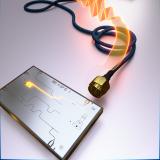
In our lab, we have realized the first quantum coherent communication protocol operated between superconducting quantum circuits located in two cryogenic systems separated by a distance of 5 meters. 

2020 virtual APS March Meeting

The 2020 APS March Meeting was cancelled due to health concerns relating to the spread of the coronavirus disease (COVID-19). The presentations of the Quantum Device Lab group members Simon Storz, Christian Kraglund Andresen, Ants Remm and Johannes Herrman were uploaded on the Virtual March Meeting platform.

New National Centre of Competence in Research (NCCR) "SPIN"

The Swiss Federal Councilor Parmelin announced the launching of 6 new National Centres of Competence in Research (NCCR), including the NCCR "Spin" in which our group is involved.

Under the leadership of Prof. Richard Warburton, University of Basel, the NCCR "SPIN" aims to make a major contribution to the development of quantum computers and create the basis for a new information-processing technology. The objective is to develop small, fast, scalable silicon-based qubits. It will also generate important findings on software and algorithm development, error correction and the architecture of future quantum computers.

The Swiss National Science Foundation (SNSF) supports the NCCR "SPIN" with CHF 17 million in the first funding phase from 2020 to 2023.

ETH Centre Quantum Science and Technology

In the second round of ETH+ the Executive Board decided to financially support the initiative ETH Centre for Quantum Science and Technology. The planned Centre will pool the quantum research activities across the engineering and natural sciences at ETH as well as the Paul Scherrer Institute PSI to strengthen this field at the national level. There are also plans to establish a joint professorship with PSI for experimental quantum technology as well as a professorship for quantum information at the Department of Computer Science.

Sebastian Krinner wins the Lopez-Loreta Prize 2018

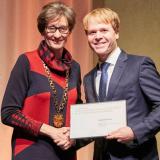
Congragulations to Sebastian Krinner for receiving the Lopez-Loreta Prize 2018, and with it a five-year research grant worth 1 million Euros.

New FET Flagship Project OpenSuperQ

Ten international partners from academia and industry - including the Quantum Device Lab -  will collaborate in a unique research endeavour to build a hybrid high-performance quantum computer. The new EU project OpenSuperQ (An Open Superconducting Quantum Computer), under the coordination of Saarland University, is part of the large-scale FET Flagship Initiative on Quantum Technologies. This unprecedented €1 billion initiative is funded by the European Commission and brings together experienced partners from across the EU.

Deterministic quantum state transfer and remote entanglement using microwave photons

Sharing information over computer networks for private, business or science-related communication is part of our everyday lives. In the future, we may use protocols based on quantum physics to realize secure communication or to perform distributed quantum information processing exceeding the capabilities of classical computers and communication networks. In our work, we take a key step toward a future quantum network by realizing a fully deterministic quantum communication protocol between two remote superconducting quantum circuits. We accomplish this protocol by emitting a single, time-symmetric, itinerant microwave photon from one node of the network and absorb at another one to transmit a quantum bit of information and establish entanglement between two distant quantum nodes on-demand.

Article: P. Kurpiers, P. Magnard, T. Walter, B. Royer, M. Pechal, J. Heinsoo, Y. Salathé, A. Akin, S. Storz, J. - C. Besse, S. Gasparinetti, A. Blais, and A. Wallraff, Nature 558, 264-267 (2018)

Single-Shot Quantum Non-Demolition Detection of Individual Itinerant Microwave Photons

Information is often transmitted using electromagnetic radiation, the quantum units of which are photons. In the microwave regime, detecting single itinerant photons at the receiving end of a transmission channel is challenging since microwave photons possess 5 orders of magnitude less energy than their optical counterparts.

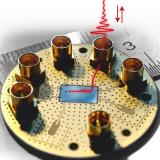
In this work, we show how to transfer the information content of  a propagating photon into an excitation of a stationary qubit. By reading out the state of the latter, we acquire knowledge about the photon’s presence without destroying it. This ‘non-demolition’ aspect opens up new possibilities of detecting the photon in flight while allowing it to travel on towards another destination. Such schemes are potentially useful for realizing logic gates between propagating photons and for creating quantum networks.

Article: J. - C. Besse, S. Gasparinetti, M. C. Collodo, T. Walter, P. Kurpiers, M. Pechal, C. Eichler, and A. Wallraff, Phys. Rev. X 8, 021003 (2018)

Studying light-harvesting models with superconducting circuits

Anton Potočnik together with his colleagues from the Quantum Device Lab and collaborators from the University of Cambridge and Princeton University shows how superconducting quantum circuits can be used to obtain insights into light-harvesting models.